
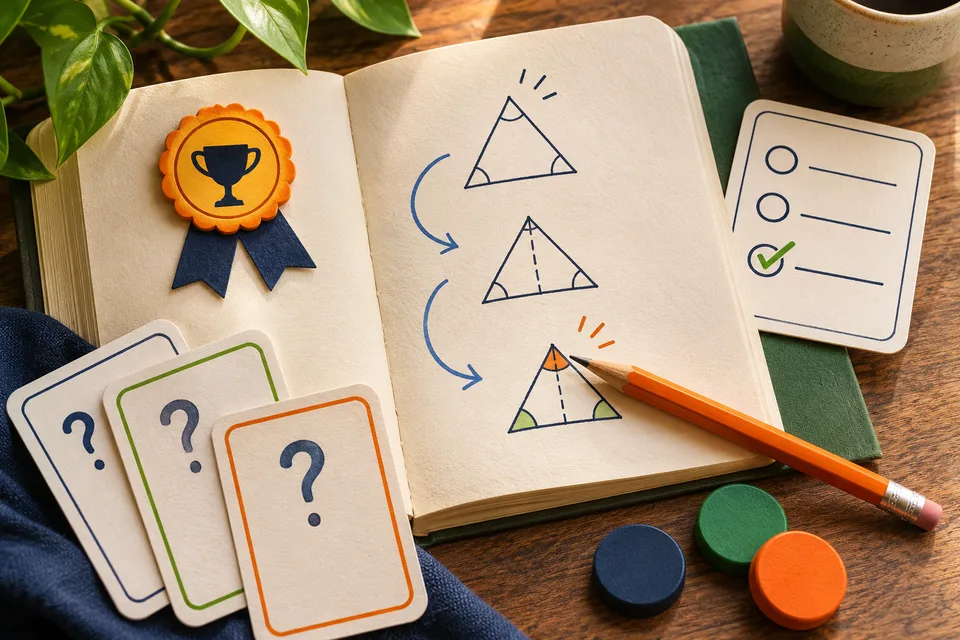
The moment after the answer
A good quiz should leave you with an explanation you can follow. A score is useful for comparing attempts and enjoying a friendly challenge. My view is that the moment after an answer deserves as much attention as the question itself.
Imagine finishing a ten-question quiz with seven correct answers. The number gives you a result. It leaves an interesting question open: what happened in the other three? A short explanation can turn that gap into the best part of the round.
Feedback has a job
There is research behind taking feedback seriously. In Butler and Roediger’s 2008 experiments, participants studied passages and answered multiple-choice questions. Immediate and delayed feedback both improved later correct recall and reduced later repetition of wrong options compared with no feedback.
Those findings concern the tasks studied. They do not establish a learning gain for every browser quiz or every player. They do give quiz makers a reason to look closely at what happens after a choice.
BrainiLab’s explanation of pretesting explores the value of an early attempt. The useful next step is checking the answer and the reasoning behind it.
Show the step that makes the answer work
Consider a simple example: what is 8 + 7? Showing “15” confirms the answer. Showing “move 2 from the 7 to make 10, then add the remaining 5” gives you a method to inspect and try again.
The explanation need not become a lecture. It should identify the decisive step, name any condition that matters and acknowledge a genuinely ambiguous question. A wrong option may be understandable. Explaining why it fails is more helpful than making the player feel foolish for choosing it.
I would also keep explanations easy to open again. A player who wants a quick round can move on. Someone who pauses should have a clear route to the reason, a reliable source or a fuller reading.
The standard I would use
When judging a quiz, I would ask whether its explanations are accurate, readable and available at a useful moment. A colourful result screen is enjoyable. The explanation is where the question can become something worth remembering.
One practical test is to explain the answer in your own words. If the reasoning still feels unclear, that is a useful question to take into the next reading.
The same care should extend to the habit around the game. Choosing between daily and anytime games helps a player find a format that fits.
Prepared with AI assistance. The examples are illustrative; the linked study provides the research evidence.