
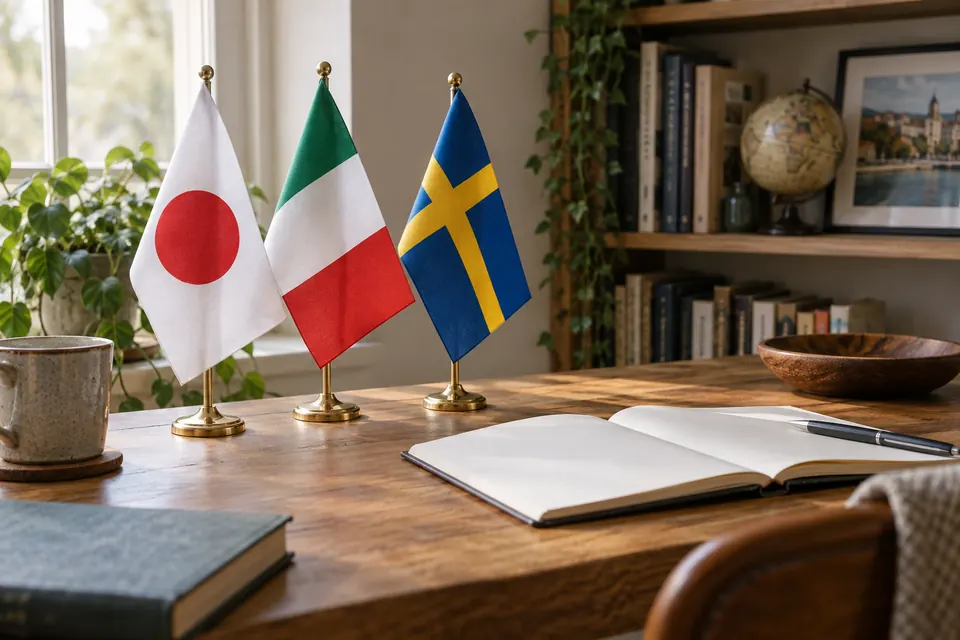
Start with five flags
To learn world flags, start with a small set, describe one distinctive detail on each and then hide the country names. A page full of stripes and stars is much harder to tackle all at once.
Try five flags from a region you like, or five you confused in a quiz. Five is a manageable starting point, not a magic memory number.
Look at the design in three steps
Before naming the country, look for three things:
- Layout: horizontal stripes, vertical stripes, a cross or a plain background?
- Colours: which ones appear, and in what order?
- Symbols: is there a star, emblem or other detail, and where is it?
The edge attached to the pole is the hoist. Standard illustrations usually place it on the left. A photograph taken from behind the flag can reverse the apparent order.
Try it with Italy
Italy’s flag has three equal vertical bands: green, white and red, starting at the hoist. Article 12 of the Italian Constitution specifies that design.
“Green by the pole, white in the middle, red at the end” gives you a more useful clue than simply remembering red and green.
Which colour is next to the flagpole?
Green. The order from the hoist is green, white, red.
France or the Netherlands? Same colours, different clue
“Red, white and blue” is a description, but it is not much of an answer. These two flags share those colours:
- France: vertical bands, blue–white–red from the hoist.
- The Netherlands: horizontal bands, red–white–blue from top to bottom.
The stripe direction separates them before you worry about colour shades. The French Presidency’s flag history explains this distinction; the Dutch Royal House confirms the Dutch colours.
For harder pairs, use an authoritative labelled reference. Subtle shades can change with screens and lighting, so two tiny thumbnails are not always enough.
Keep a short list for next time
After a round, note two or three flags you were unsure about, including lucky guesses. Write the clue you missed: “vertical, blue by the pole” is more useful than “remember France”.
Before your next round, cover the labels and name those flags again. Add a few more once you can explain how you recognise the first set. Recognising an answer and recalling it are different challenges.
For a design that breaks the rectangle pattern, take a look at Nepal’s double-pennant flag.