
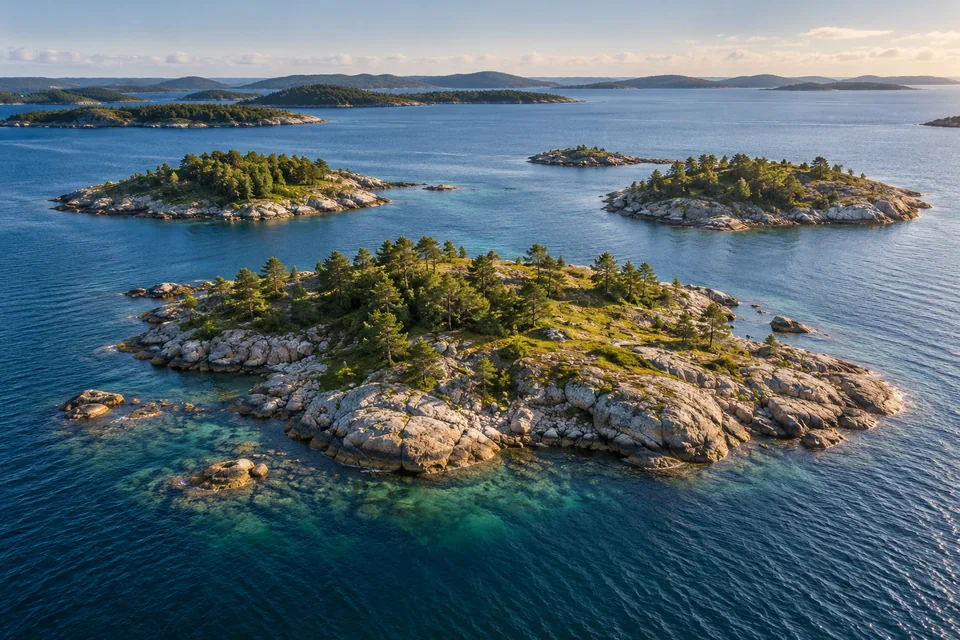
One island, or the whole group?
An archipelago is a group or chain of islands. The word describes the collection, rather than just the largest island you might notice first.
Think of looking down at several pieces of land separated by water. One island has company; the whole gathering gets its own geographical name.
Not always a string of dots
A chain is easy to picture: islands lined up like beads. But an archipelago can also be a scattered group, rather than a neat procession.
Here is the less obvious part: NOAA’s definition includes islands in lakes and rivers as well as the ocean. You do not need a vast tropical sea to qualify.
A moving plate makes a trail
Hawaii offers one way to build an archipelago. Magma rose at a volcanic hot spot beneath the Pacific Plate, building islands as the plate moved over it.
NOAA explains how that movement produced the Hawaiian island chain. Imagine a moving strip of paper passing over a fixed drawing point: the marks appear in a trail. It is a comparison, not the literal machinery underground.
The name is not a recipe
Other archipelagos have different stories. Erosion, sediment build-up and changing sea levels can also help produce island groups. They do not all follow Hawaii’s volcanic route.
For two more watery map words, explore what makes an atoll and what makes a fjord. Geography has names for some wonderfully different shapes.