
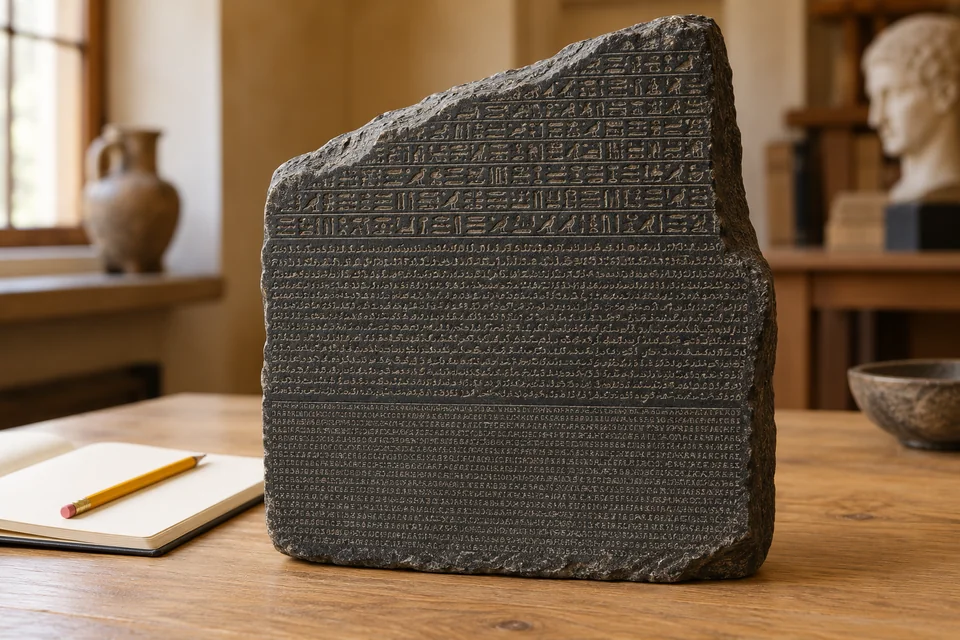
A stone with a clue
The Rosetta Stone is a broken ancient Egyptian slab bearing a decree in three scripts. Comparing those versions helped scholars learn to read Egyptian hieroglyphs.
Its importance comes from the repeated message. Imagine finding the same unfamiliar notice beside a version you can understand: suddenly, you have something to work with.
Three scripts, two languages
The British Museum dates the inscription to 196 BC. It concerns King Ptolemy V, rather than a secret map or a buried treasure.
The writing appears in Egyptian hieroglyphs, Egyptian Demotic and Ancient Greek. That means three scripts, but two languages: hieroglyphs and Demotic are different ways of writing Egyptian.
The part they could read
Scholars could already read Ancient Greek. This gave them a route into the corresponding Egyptian text, including clues in royal names.
Progress still took years. Thomas Young made important advances, and Jean-François Champollion announced a crucial breakthrough in 1822. He worked with the stone and other texts; one glance at the Greek did not solve everything.
A clue, not a magic key
That is what makes the story satisfying: familiar information helped make unfamiliar information readable. The stone supplied a comparison, and researchers did the difficult work.
For another shift in historical perspective, compare Cleopatra, the pyramids and the Moon landing. Or try reading a different system with Roman numerals.