
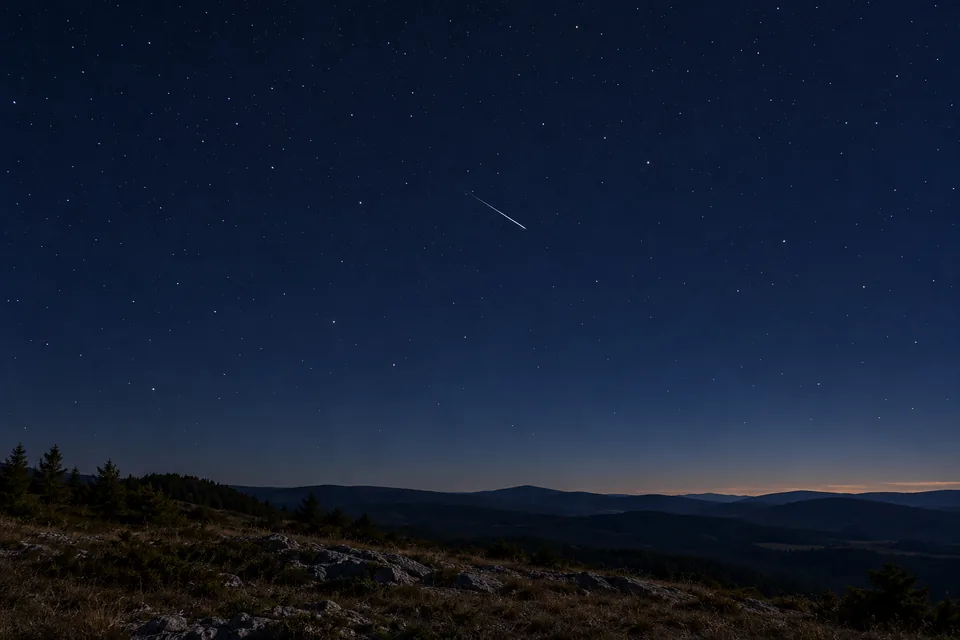
Earth keeps the appointment
The Orionids return every October because Earth crosses a trail of debris left by Halley’s Comet. The comet does not have to visit us each year. The material is already waiting along its path.
NASA identifies Halley as the source of the Orionids. Think of the shower as Earth meeting a traveller’s old trail, rather than a fresh arrival by the traveller.
A comet leaves crumbs
As a comet approaches the Sun, warming releases dust and rocky particles. This material gradually spreads along its orbit. Earth’s own yearly journey brings us through the Orionid debris stream again.
Halley also supplies the debris for the Eta Aquariids in May. One comet can leave more than one appointment in Earth’s calendar.
What makes the streak?
A particle entering our atmosphere at high speed heats the air around it. The bright streak is a meteor: a brief glow in the atmosphere, not a star falling out of the sky. NASA Space Place explains how a meteor shower works.
The repeating route explains the season, but it does not promise an identical show. Moonlight and viewing conditions affect how many faint streaks people notice.
Orion is the signpost
The streaks appear to come from the direction of Orion. That apparent starting point gives the shower its name; Orion’s distant stars are not launching the particles.
It is a perspective effect, rather like parallel railway tracks appearing to meet in the distance. For other tricks of the night sky, explore why stars twinkle and what colours the northern lights.
Orion supplies the signpost, Halley supplies the debris, and Earth makes the return trip.