
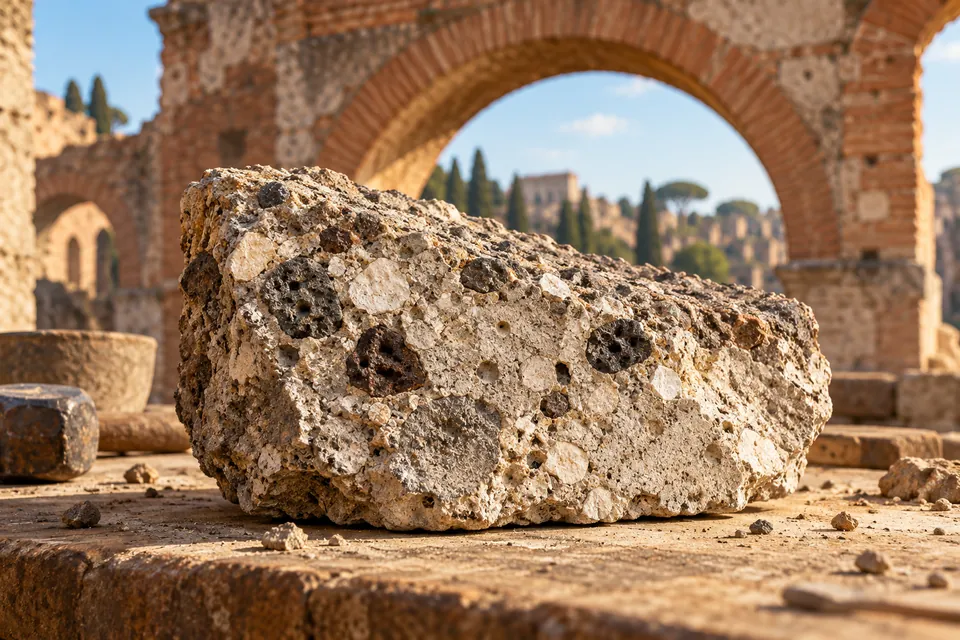
A wall with a useful trick
Some Roman concrete can seal small cracks when water reaches lime-rich fragments inside it. This helps explain its durability, alongside reactions involving volcanic ingredients.
It is a lovely reversal: the interesting part of an old wall may be the little lumps you would have expected a careful builder to remove.
The white fragments matter
In research reported by MIT in 2023, scientists examined pale pieces called lime clasts. These can supply calcium when water enters a crack. New mineral deposits can then fill the gap.
The proposed preparation method was hot mixing: using reactive quicklime produces heat when water is added. The resulting material retains calcium-rich fragments instead of becoming perfectly uniform.
Pompeii left the ingredients on the table
A 2025 study of an unfinished construction site at Pompeii found quicklime already mixed with dry volcanic material. The city’s burial in 79 CE had preserved a worksite, not just a finished wall.
MIT’s account explains why that mattered: the raw piles showed how builders prepared their mixture. The archaeological evidence supported a method earlier inferred from finished concrete.
A repaired crack is not an immortal building
In the 2023 laboratory tests, researchers deliberately cracked their test samples and passed water through them. Within two weeks, cracks in the quicklime-containing samples had sealed and water stopped flowing through.
That was a laboratory result, not proof that every Roman wall repairs itself. Recipes and conditions matter. The fascinating finding is that an apparently passive building material can still react.
For another ancient surprise, compare Cleopatra’s lifetime with the pyramids and the Moon landing.