
The colour was chosen for an audience
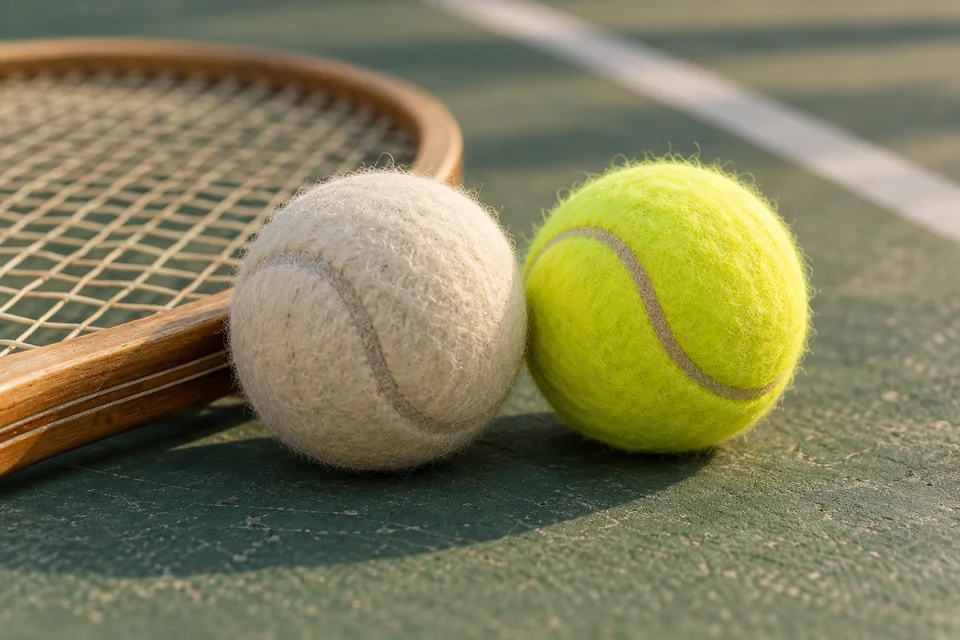
Picture a tennis ball and you probably imagine a bright yellow blur. But yellow was not always the familiar choice. The International Tennis Federation’s history describes earlier balls as black or white, chosen according to the court background.
The push towards yellow had a practical reason: making the ball easier to follow on television. A ball can be perfectly playable on court and still be difficult for someone watching a screen to track.
1972 and 1986 tell different parts of the story
In 1972, the ITF added yellow balls to the rules after research found them more visible to TV viewers. That date marks a rule change, not a day when every tournament replaced its balls.
Wimbledon continued with white balls until 1986. Its own museum learning material confirms the change and links it to visibility on colour television.
- 1972: yellow balls enter the ITF rules.
- 1986: Wimbledon starts using them.
The gap is fourteen years. Keeping the two events separate avoids turning a gradual change into a misleading single-date fact.
A different way to watch a rally
Next time you watch a match, follow just the ball for one rally. On the next, watch the players’ movement instead. What information becomes harder to notice when you change your focus?
This is an observation exercise, not a comparison of ball colours. Your screen, the camera angle and the particular footage all affect what you see. It is simply a way to notice how much a televised sport asks your eyes to follow at once.
Would this caption be right?
An archive clip is labelled “Wimbledon, 1980”, and its tennis balls are white. Someone says the caption must be wrong because tennis switched to yellow in 1972. Are they right?
Check the reasoning
No. Wimbledon’s change came in 1986. White balls in a 1980 clip fit that timeline. The colour alone would not prove the clip’s exact date, though.
For another detail that makes a match easier to follow, try reading a tennis score from love to deuce. Knowing what changes—and when—is useful off the court too.