
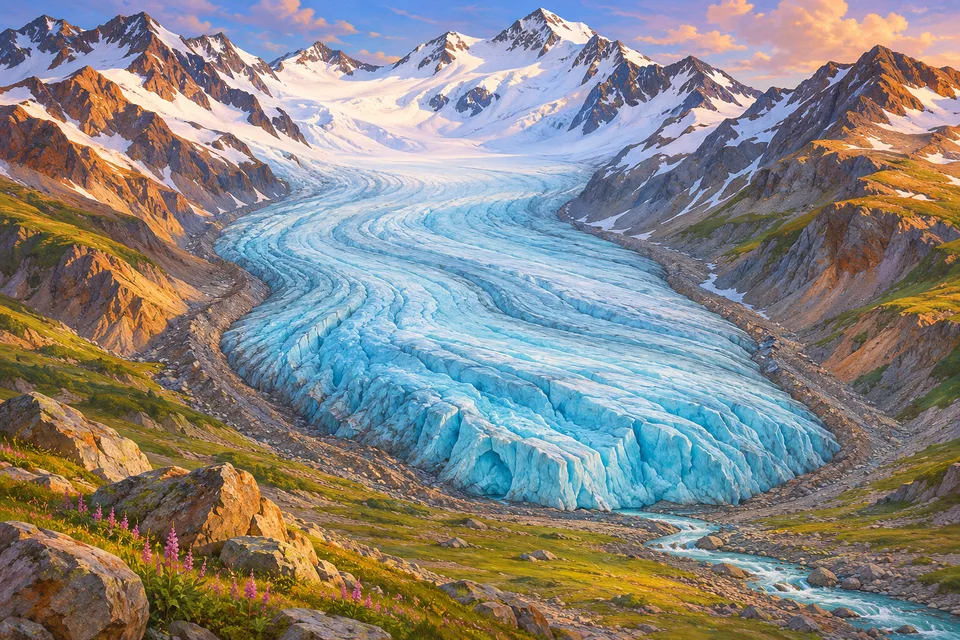
It starts with snow that survives
Glaciers form when snow builds up over years, becomes dense ice and grows thick enough to flow under its own weight. The crucial ingredient is snow left over after the melting season. A cold place alone is not enough.
Imagine two mountain hollows after the same snowy winter. One loses all its snow before the next winter arrives. The other keeps a layer, ready to be buried by fresh snowfall. Only the second has a lasting store to build on. This is an illustrative comparison, not a measurement from a particular glacier.
The US Geological Survey’s glacier guide makes movement part of the definition. An old patch of snow is not automatically a glacier.
From loose snow to dense ice
New snow buries the older layers. The grains change shape and join together as the snow becomes denser. Air spaces shrink. Snow that survives a melting season becomes firn, an intermediate stage on the way to glacier ice.
The National Snow and Ice Data Center describes this gradual compaction and growth of ice crystals. There is no single formation time that fits every glacier: snowfall, losses and local conditions all matter.
Snow and glacier ice can also look surprisingly different. The USGS explains that ice absorbs more red light, while blue light travels through and scatters within it. A longer path through ice can make the blue more noticeable. For the other half of the colour puzzle, explore why snow looks white.
How can solid ice move?
A glacier does not need to turn into a river of liquid water to move. Its enormous weight makes the ice slowly deform. Where conditions allow, it can also slide over the ground beneath it.
A valley glacier flows down its valley. An ice sheet spreads outwards from its thick interior. The surface can crack where the stresses become too great, creating crevasses.
That moving ice also helps explain the landscape left behind. The National Park Service describes glaciers carving U-shaped valleys and carrying rock debris. A coast flooded after glacial carving can become a fjord.
Retreat does not mean reverse
A glacier’s front, or terminus, can retreat while the ice continues to flow down-valley. “Retreat” describes the changing position of that front, not ice climbing back up the mountain.
The National Park Service’s glacier anatomy guide separates ice arriving at the front from ice being lost through melting or pieces breaking away. If losses outpace the supply, the front moves back. Watching the edge alone can hide the continuing movement within the glacier.
Formation and survival therefore depend on a balance: what accumulates, what is lost and how ice moves through the system. Even very cold regions need enough snowfall. Our reading on Antarctica as a desert explains why a vast store of ice can coexist with a dry climate.