
A bounce that keeps its order
A mirror forms an image by bouncing light off a smooth surface in a predictable direction. A wall reflects light too, but its rough surface scatters it in many directions. A flat mirror preserves the pattern well enough for you to see where the light appears to come from.
The law of reflection gives the rule. Measure the angle of the incoming ray from an imaginary line perpendicular to the mirror. The reflected ray leaves at the same angle on the other side of that line. In many household mirrors, a thin layer of silver or aluminium behind the glass provides the reflecting surface.
Why the cup looks behind the glass
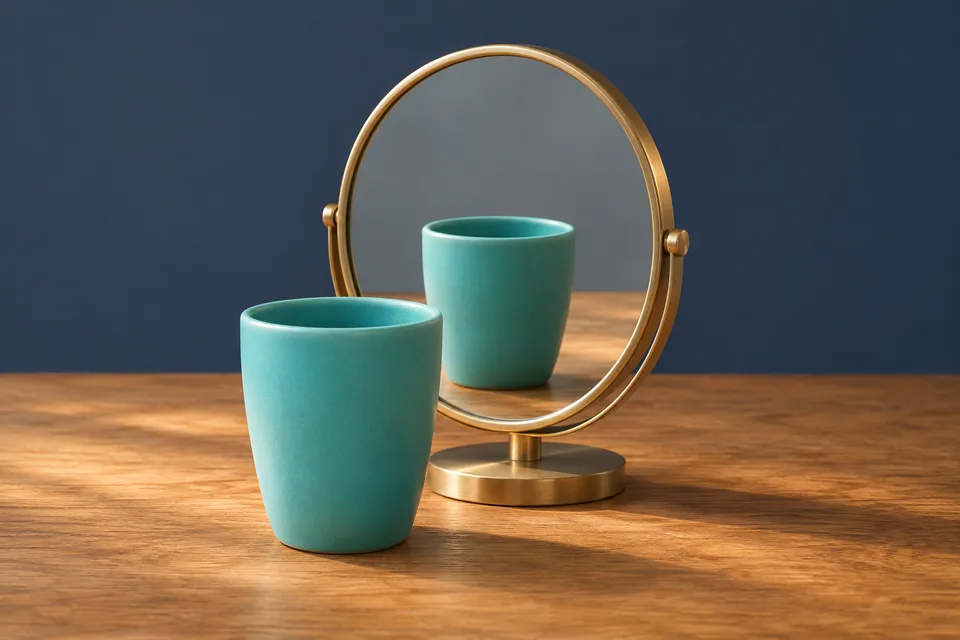
Put a cup 30 centimetres in front of a flat mirror. Its image looks 30 centimetres behind the mirror, measured straight back from the surface.
The light reaching you has bounced towards you. Trace those reflected paths backwards in straight lines and they meet at the apparent position of the cup. That is what physicists call a virtual image. The paths only appear to come from behind the mirror.
Which direction changes?
Hold a cup next to the left edge of the mirror. Its reflection stays next to that same edge. Now move it closer to the glass. The reflection moves closer too, from the other side.
The reflection reverses the direction into and out of the mirror. Directions along the glass stay the same. To see what happens when a drop of water both bends and reflects light, follow the path of light through a raindrop.