
Ordinary objects, surprisingly good questions
These ten short reads explain how familiar objects work, or how they found their purpose. Pick something you use every day and look a little closer.
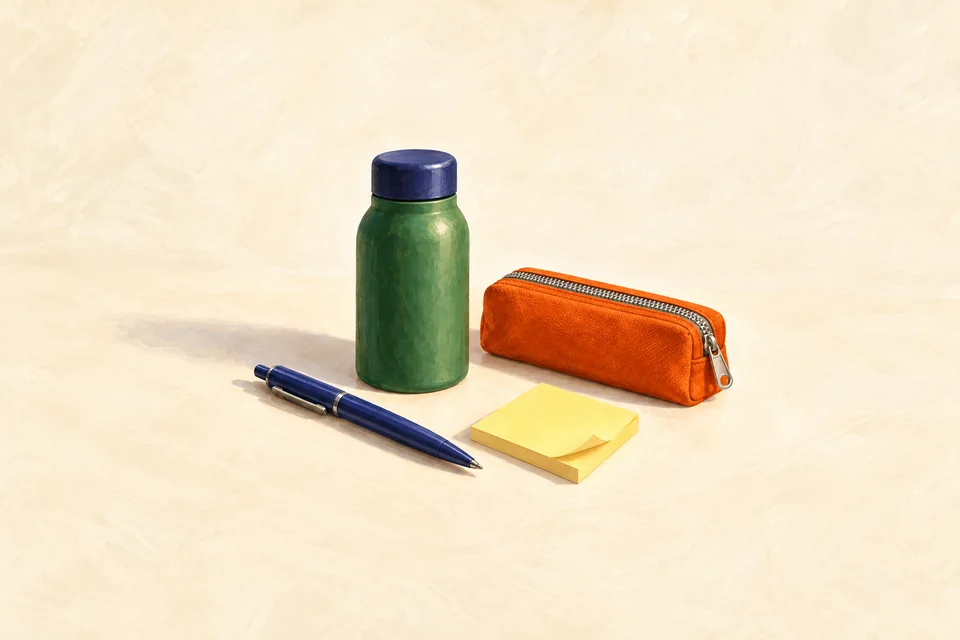
A pen has a moving part small enough to miss. A flask has a useful gap. Your desk is already a cabinet of curiosities; it just lacks the little museum labels. Start anywhere.
At your desk
- Why is there a tiny ball in your pen? Follow the ink from pen to paper.
- Why is your keyboard not in ABC order? Meet QWERTY, the layout your fingers know.
- How did Post-it notes begin? A bookmark problem takes a colourful turn.
Clever ways to hold things together
- Was bubble wrap really meant to be wallpaper? An unlikely beginning for a familiar parcel protector.
- How do hook-and-loop fasteners grip? Take a closer look at that satisfying rip.
- How does a zip join its teeth? A tiny slider has a lot to organise.
At home and on the move
- How does a toilet flush? Follow what happens after you press the button.
- Why does a microwave spin your dinner? Find out what the moving plate is for.
- How does a flask keep a drink hot? The gap between its walls does useful work.
- How do noise-cancelling headphones work? More sound can sometimes mean less noise.
One tiny detail to notice
The National Inventors Hall of Fame describes the rolling ball that carries a pen’s ink onto paper. The Royal Institution’s early vacuum flask shows a different solution: insulation between two walls.
Next time you pick up an ordinary object, ask which little detail makes it useful. You may never look at your pencil case quite the same way.