
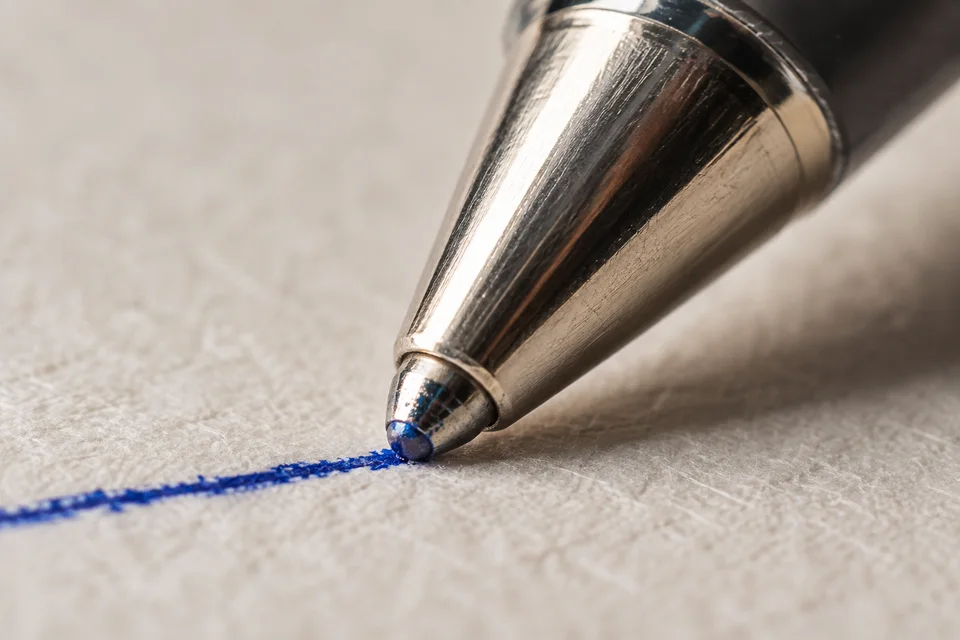
The point is a moving part
The tiny ball rolls ink onto the paper as you write. A ballpoint pen’s tip looks like a fixed metal point, but the ball turns as it travels across the page.
The ball sits in a small holder called a socket. Behind it is the ink supply, called the reservoir. As the ball turns, its surface picks up ink and carries it onto the page. That small moving part gives the pen its name.
Better ink needed a different way out
The National Inventors Hall of Fame credits László Bíró with the modern successful ballpoint pen. As a journalist, he noticed that newspaper printing ink dried faster than fountain-pen ink.
But putting printing ink into a fountain pen did not solve the problem: it was too thick to flow through the tip. Bíró developed a rotating-ball design that could carry ink onto the paper instead.
Changing the ink alone was not enough. The ink and the way it reached the page had to work together.
A tiny component has a demanding job
The ball needs to keep its shape while rubbing against paper. For example, BIC says its Cristal pen uses a ball made of tungsten carbide, a hard material that resists wear. That is a detail of that product, not a claim that every ballpoint uses the same material.
The same manufacturer’s description gives a useful size comparison: its medium point measures 1.0 millimetre, while the stated line width is 0.4 millimetres. The distance across the ball is its diameter. It is not the same as the width of the line it draws.
Can you sketch the ink’s journey?
On a scrap of paper, draw three things: a tube of ink, a ball partly held in a socket, and a line underneath. Add an arrow showing the ball turning.
Which part of the sketch must touch both the ink supply and the paper as it moves?
Show the moving part
The ball’s surface. The reservoir stores the ink; the rotating ball carries it to the page. The socket keeps the ball in position while allowing it to turn.
Try explaining your drawing without using the word “pen”. If someone can follow how the ink gets onto the paper, you have described the mechanism rather than simply named the object.
For another design hidden in a familiar object, look at the hooks and loops in a reusable fastener.
Your bag has another small moving part doing a big job: the slider that joins a zipper’s teeth.