
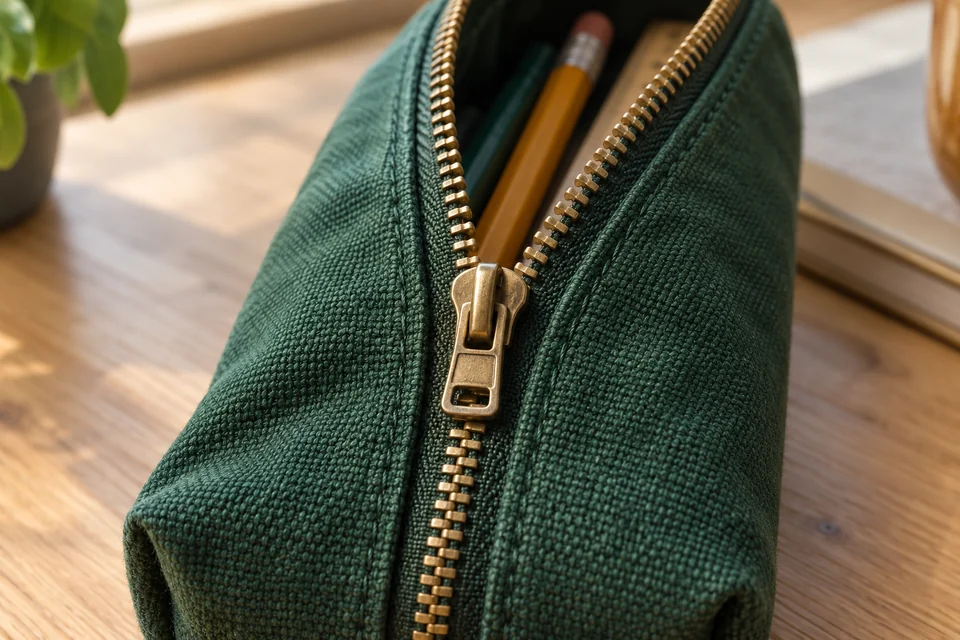
A little machine hiding on your pencil case
Closing a bag takes a second. But look closely at the zip: you are joining dozens of tiny pieces without touching each one.
A zipper closes because its teeth fit together. The sliding part guides them into place, one after another. Pull it the other way and it separates them again.
The teeth are also called elements. They stay attached to two strips of fabric. YKK’s explanation of zipper construction shows how the pieces work together.
Find these three parts
Take a look at a zip on a bag or jacket. This little map will help you name what you see.
| Part | Where to look | What it does |
|---|---|---|
| Teeth, or elements | The rows beside the opening | Fit together to close the gap |
| Slider | The small body behind the tab you pull | Guides the teeth together or apart |
| Tape | The fabric strip on each side | Carries the row of teeth |
The pull tab is your handle; it is not the whole slider. You can see both parts labelled in YKK’s zipper manual (page 1).
The clever bit is in the shape
A row of smooth beads would not do the same job. The pieces need shapes that engage with their neighbours.
In Gideon Sundback’s 1917 fastener patent, each tooth has a little hollow on one side and a raised bump on the other. A bump fits into a neighbouring hollow, helping the pieces hold together. The patent describes a sliding device that connects or separates the rows.
It is a lovely design question: how can something hold together, yet come apart when you want it to? A zip answers it with carefully shaped pieces and a guide.
Some zips have a hidden brake, too
The teeth fitting together and the slider staying put are two different jobs.
Some sliders include a small locking pin that catches on the teeth. Moving the pull tab releases it. Other locking sliders release when you gently pull the tab, so the details vary. YKK shows both locking designs.
That is why a zip can move smoothly in your hand but stay where you leave it.
Try a ten-second zipper challenge
Use an ordinary bag zip that moves freely. Open it halfway, then slowly close a short section. Watch just beside the slider. Stop if fabric catches; there is no need to force it.
Which part travels along the opening: the teeth or the slider? Make your choice before revealing the answer.
Show me what to look for
The slider travels along the opening. The teeth remain on their fabric strips, joining as the slider passes. Reverse your hand’s movement and watch the joined section become two rows again.
Now compare it with the fastener inspired by a burr. Both let you open and close something repeatedly, but they solve the problem in different ways.
Another tiny part doing a big job: the ball inside a ballpoint pen. Your pencil case is full of small inventions worth a closer look.