
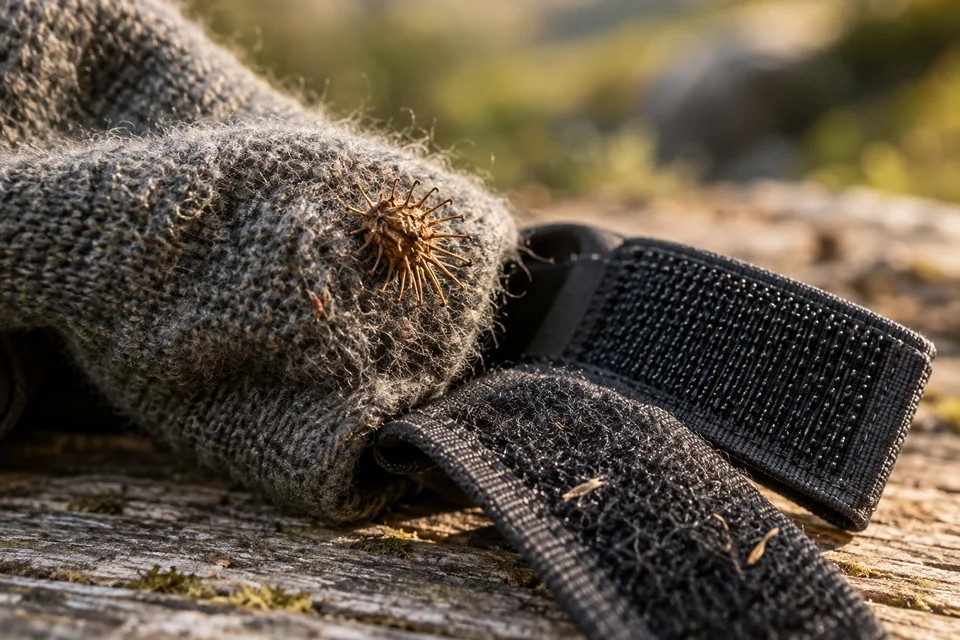
Tiny hooks meet a soft tangle
A hook-and-loop fastener grips because tiny hooks on one strip catch loops on the other. Press the faces together and many little connections form. Peel them apart and the hooks release.
The two fastening faces hold mechanically, rather than with sticky glue between them. A product may still have an adhesive backing to attach the strip to something else.
What does a plant burr have to do with it?
Swiss engineer George de Mestral noticed how burrs’ small hooks clung to clothing. That suggested a reusable fabric fastener.
The National Inventors Hall of Fame records his 1955 patent and the challenge of making hundreds of tiny hooks on cloth tape. A nuisance after a walk had become an engineering idea.
Is every hook-and-loop fastener called Velcro?
VELCRO is a brand name; hook-and-loop is the general type of fastener. The familiar version needs two different surfaces doing different jobs.
Look closely at a strap: one side is a softer tangle, the other has firmer little hooks. Pressing against a smooth sheet cannot supply the missing loops.
A different way to make something removable
Compare it with a Post-it note’s removable adhesive. Both let you attach and remove something, but the grip works differently. Same everyday job, two rather different solutions. Or follow a zipper’s slider to see how it joins two rows of teeth.
Look at more clever little details in how everyday things work.