
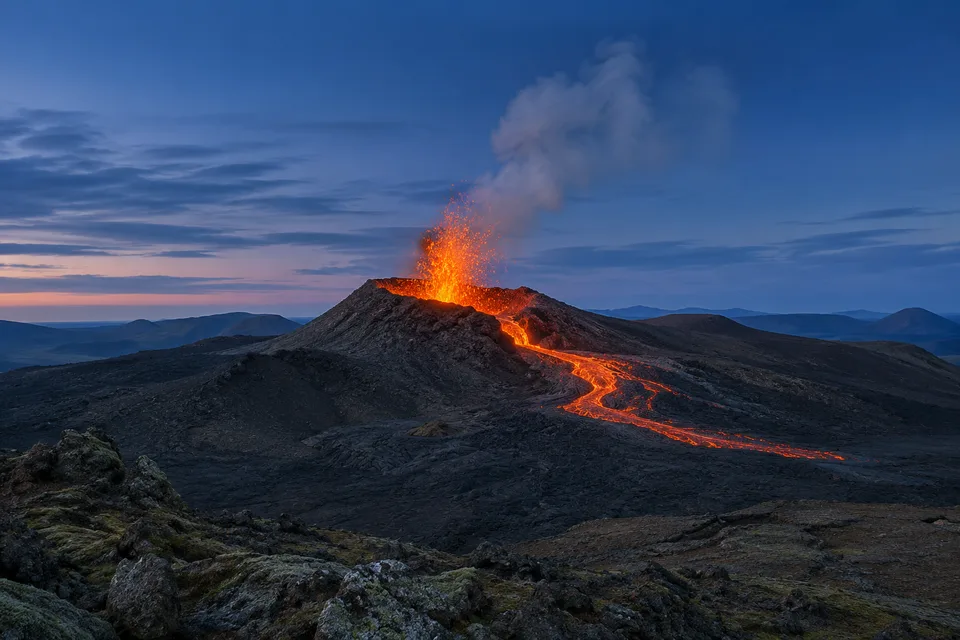
From magma to lava
Volcanoes erupt when material from inside Earth escapes through an opening at the surface. In eruptions involving fresh magma, buoyancy and gas pressure help move the molten mixture upwards. Expanding gas can drive an explosion, while other eruptions release flowing lava.
The names describe where the material is. Below ground, it is magma: molten rock mixed with crystals and dissolved gases. Once it erupts, the molten rock is called lava. It does not need to change its ingredients to acquire a new name.
Magma can rise because it is less dense than the surrounding rock. It moves through fractures and can collect in linked storage areas beneath a volcano. The US Geological Survey’s explanation follows this path from underground storage to a surface vent.
What changes as magma rises?
Deep underground, pressure helps keep gases dissolved in the molten material. As magma approaches the surface and the surrounding pressure falls, gases can separate from the melt and form bubbles. Those bubbles expand, helping to propel an eruption.
Water and carbon dioxide are common volcanic gases. The National Park Service compares their release with a carbonated drink: reducing the pressure lets dissolved gas come out as bubbles. That is a comparison about pressure, not a claim that a volcano needs shaking.
How quickly magma rises also matters. Slow ascent can give gas more time to escape; rapid ascent can release it much more abruptly. There is more to an eruption than simply making rock hot.
Why does one eruption flow and another explode?
A useful word is viscosity: resistance to flowing. Low-viscosity magma is relatively runny, and gas can often escape more easily. It may reach the surface as lava flows in an effusive eruption.
More viscous magma resists movement. If gas remains trapped, pressure can build and the material may break apart in an explosive eruption. The British Geological Survey describes both eruption styles.
But “sticky means explosive” is not a complete rule. Sticky magma that has lost enough gas can instead squeeze out and pile up into a lava dome. Composition, gas content and the way magma moves all influence what happens. A fountain of glowing lava and a column of ash can therefore represent different ways of releasing volcanic material.
Volcanic ash is not the ash from a fire
An explosive eruption can tear magma into fragments and eject pieces of older rock. The small particles called volcanic ash can include rock, minerals and volcanic glass. They are not the soft remains of something that has burned.
The National Park Service’s guide to volcanic ash explains how expanding gas can shatter material into tiny pieces. Larger fragments and fine ash are both types of tephra: material thrown through the air by an eruption.
A dark plume in a photograph therefore tells a different story from a flame or a lava flow. Its appearance alone does not reveal every ingredient in the eruption.
Why do volcanoes form in particular places?
Many volcanoes occur where tectonic plates pull apart or where one plate sinks beneath another. Volcanoes also form at hot spots, including places far from a plate boundary. The British Geological Survey explains these three settings.
A plate boundary is not automatically a line of volcanoes. At boundaries where plates mainly slide past each other, volcanoes do not typically form because a suitable magma supply is usually absent. For the separate question of how shaking travels through rock, read why an earthquake can be felt far away.
And not everything described as erupting is ejecting lava. A geyser shoots out hot water and steam. Comparing what comes out of the opening helps separate two striking events with very different underground processes.