
A shake from somewhere else
Imagine sitting quietly when your chair gives a small wobble. Later, you hear that an earthquake began far from your town. How could something happening there move the floor here?
The ground connects the two places. An earthquake sends vibrations through Earth, and those vibrations can reach people a long way from where the movement began. The moving message is a wave.
The rock slips; the movement travels
The outer part of Earth is broken into enormous pieces called tectonic plates. As these pieces move, rocks along a fault—a break where rock can move—may get stuck while forces keep building. When the rocks suddenly slip, stored energy is released.
That energy spreads out as seismic waves. Seismic simply means related to earthquakes. The USGS compares their spread to ripples on a pond. The comparison describes energy travelling outward; it does not mean solid ground turns into water.
Think of people passing a gentle squeeze along a line of joined hands. Nobody has to walk from the first person to the last. The disturbance travels while each person moves only a little. Rock can also pass a disturbance along without travelling across the country.
The shaking arrives in different ways
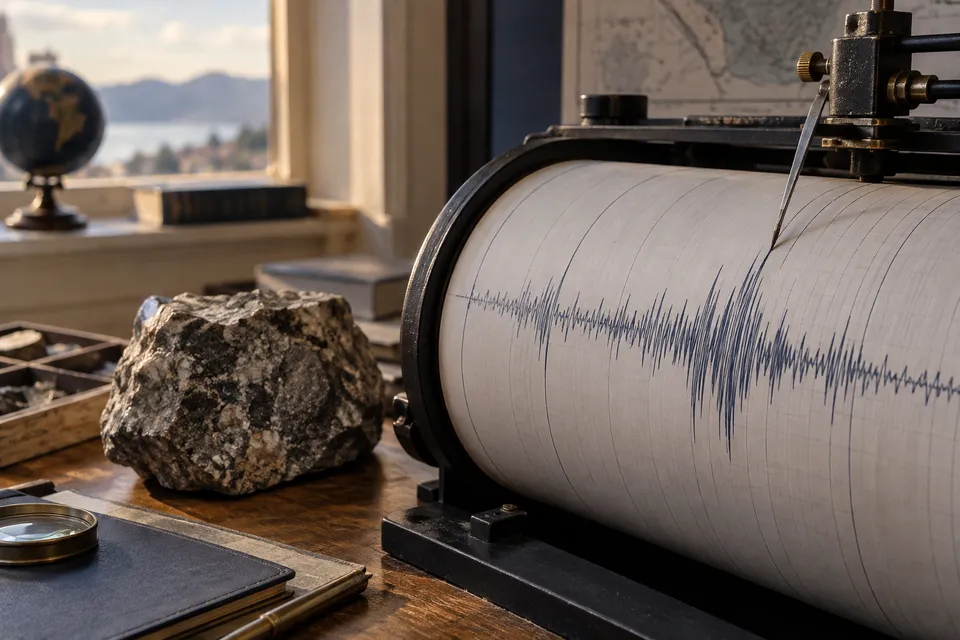
An earthquake does not send just one kind of wave. P waves squeeze and stretch material in the direction they travel. S waves move material across that direction. P waves travel faster, so recording instruments usually detect them first.
Other waves travel along Earth’s surface. Different arrivals help explain why shaking may feel like a quick jolt followed by a longer rolling movement. Your distance from the earthquake, and the ground beneath you, also affect the experience. The USGS guide to what earthquakes feel like describes these differences.
Farther away usually means less shaking
As waves spread, their energy is spread over a larger area. Some energy is also lost along the way. That usually makes the shaking weaker farther from its source, as the USGS explanation of distance effects shows.
But distance is only part of the story. Waves travel through different types of rock, and shallow ground beneath a place can change how it shakes. Two towns equally far away may therefore have different experiences. There is no single distance at which every earthquake stops being felt.
One earthquake, many experiences
Magnitude describes the size of an earthquake at its source. Intensity describes how strongly the shaking is experienced in a particular place. The USGS distinguishes these two measurements because they answer different questions.
A useful comparison is a speaker playing music. Its output and how loud the music sounds at your chair are related, but they are not the same thing. Move farther away, or put a wall between you and the speaker, and your experience changes.
So a faraway wobble does not mean the earthquake began beneath your feet. It means waves reached you. A single sudden slip can send a travelling disturbance through the ground—and many places can feel different parts of that same story.