
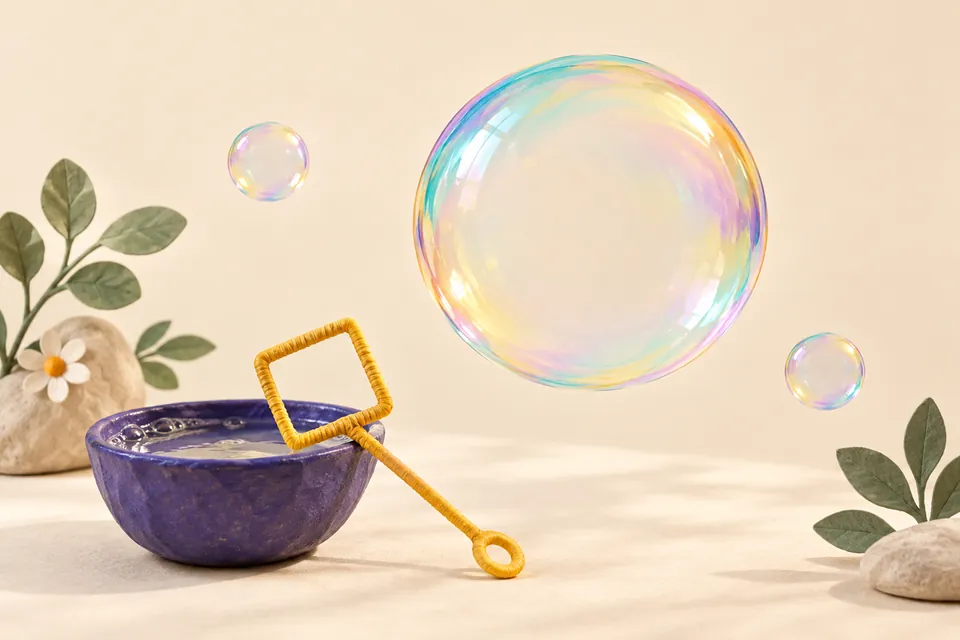
A square wand, a round surprise
A free-floating soap bubble tends to form a sphere because surface tension pulls its film towards the smallest surface area for the air inside. For a given volume, that shape is a sphere.
Use a square bubble wand and you still do not get a procession of floating cubes. Once a bubble breaks free, the wand no longer holds its edges in place. The film can settle into its own shape.
What is surface tension?
Molecules in a liquid attract one another. At its surface, those attractions make the liquid resist being stretched over a larger area. That effect is called surface tension.
A soap bubble is air enclosed by a very thin liquid film. The Exploratorium explains how the film tends to shrink. The air inside resists being squeezed, so the bubble does not simply collapse to a point.
Picture wrapping the same parcel with less paper. The amount inside stays the same; the covering uses less area. A sphere is the bubble’s neatest wrapping.
Does soap make the pull stronger?
Here is the twist: soap lowers water’s surface tension. It does not increase it. Try blowing lasting bubbles with plain water and you will soon notice the difference.
The Exploratorium describes soap’s double role: it reduces the surface tension and helps the thin film last longer, including by slowing evaporation. The film can stretch into a bubble without disappearing almost immediately.
The bubbles in the washing-up disagree
Look at a cluster of bubbles and many seem squashed or angular. Touching neighbours change the conditions: the bubbles share films rather than each floating alone.
The Exploratorium’s bubble activity explores these changing shapes. “Bubbles are round” is a helpful starting point for an isolated bubble, rather than a rule that every bubble must obey.
Fancy another everyday puzzle? Discover why chopping an onion can make you cry. Even the washing-up and dinner prep have their own physics and chemistry.