
The air does the colouring
The sky looks blue because tiny molecules in the air scatter blue sunlight more strongly than red sunlight. Scattering means sending light off in different directions.
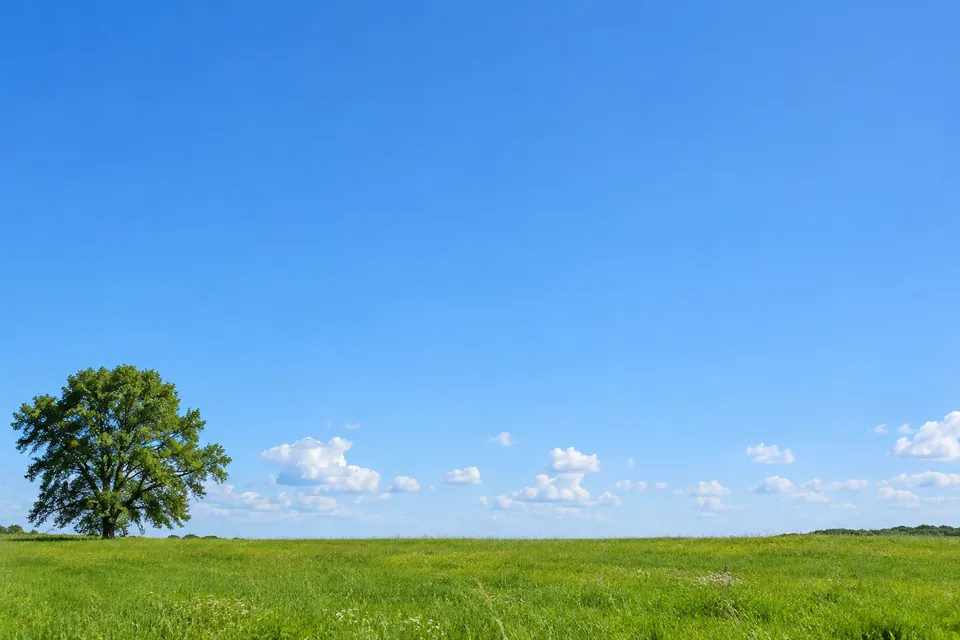
Picture a green field far from the coast. The sky above it can still be blue. The Royal Observatory explains why the sea is not painting the sky: the colour comes from the atmosphere, the layer of gases around Earth.
Sunlight has more than one colour
Sunlight may look white, but it contains the colours of the rainbow. NASA shows how a prism separates them. A prism is a clear, specially shaped object that bends different colours by different amounts.
Light travels as waves. Wavelength is the distance from one wave peak to the next. Blue light has a shorter wavelength than red light, as NOAA explains. “Shorter” describes the wave, not a slower speed.
Why blue reaches you from all around
Air molecules scatter short wavelengths more strongly than long ones. Blue light spreads out and can reach your eyes from many parts of the sky, rather than only from the Sun’s direction.
This is called Rayleigh scattering. The Met Office connects it to the tiny gas molecules in the air. The air is not blue paint, and the light has not turned into a new colour; different parts of sunlight have taken different routes.
Why not a violet sky?
Violet has an even shorter wavelength and is scattered strongly too. But our eyes respond more to blue, and sunlight contains less violet. The Met Office explains why the result looks blue to us.
So a familiar blue afternoon hides a small sorting trick: the air redirects some colours more than others. In the next lesson, the Sun takes a longer route through that same air.