
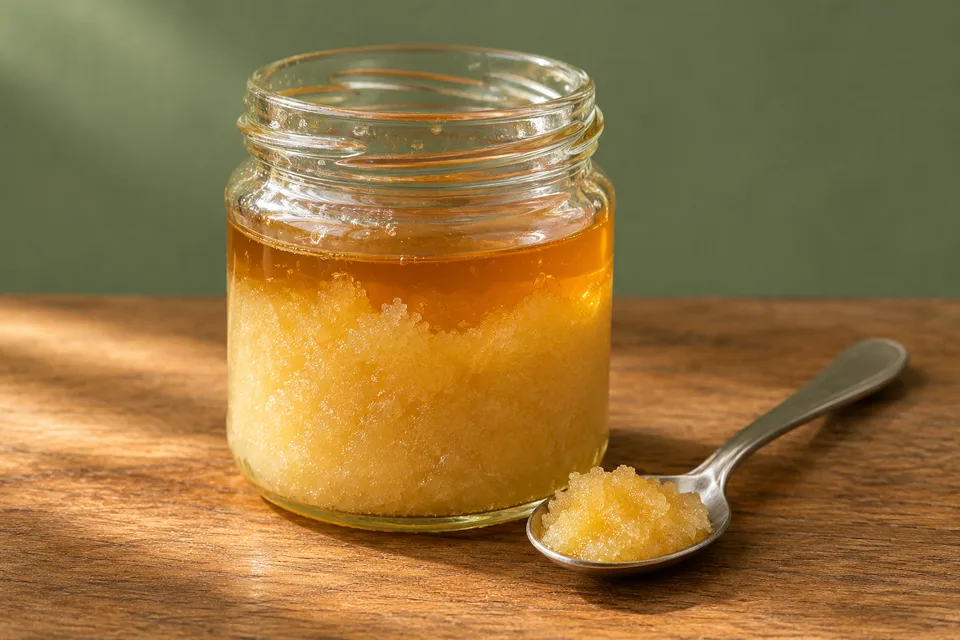
Where do the grains come from?
Honey crystallises when some of its dissolved glucose forms solid crystals. Honey is mostly sugar with a little water. Glucose dissolves less readily in water than fructose, another sugar in honey. As glucose crystals grow, you may see a cloudy patch or feel grains on the spoon.
In a study of single-flower honeys, researchers tracked colour and thickness as the samples changed. As the crystals spread through the honey, they can make it thicker and less transparent.
Why does one jar change first?
Picture two jars on the same shelf. One is still clear enough for light to pass through. The other has turned cloudy. Even if both jars sat at the same temperature, their balance of sugars and water could differ.
In a comparison of 136 honeys, researchers linked faster crystallisation with less fructose relative to glucose and with lower water content. The flowers the bees visited can help explain why the sugar balance differs from jar to jar.
How does a crystal get started?
A tiny crystal can give dissolved glucose a surface to build on. In a study of spring blossom honey, researchers compared batches started with small crystals and batches without added crystals. They measured how big the crystals grew and how creamy the honey felt.
Crystallisation changes how honey feels as some of the sugar goes from dissolved to solid. In a popping kernel of corn, a different change of state takes place. Some of the liquid water turns into gas and expands.