
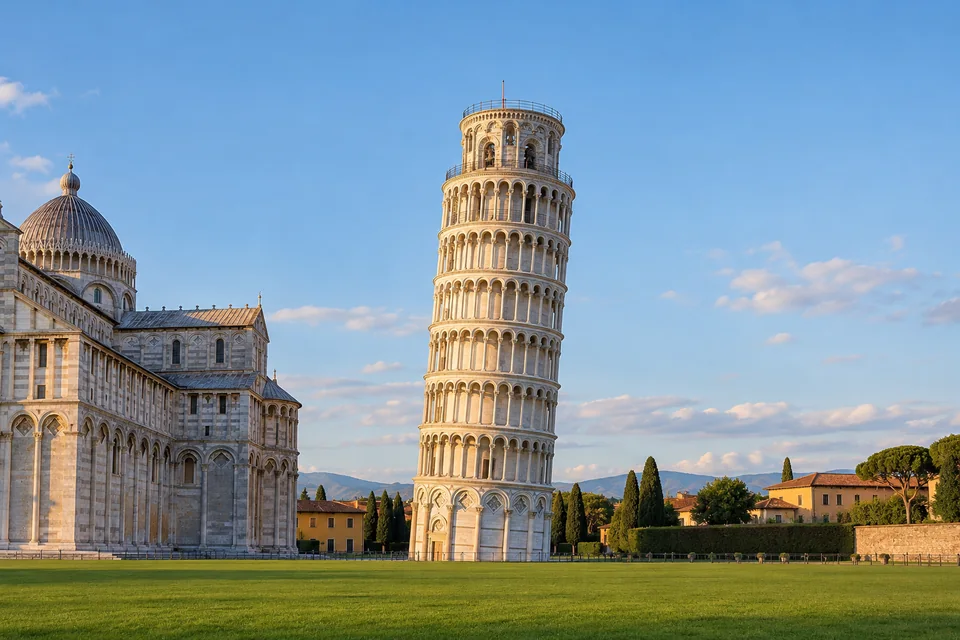
An accidental lean
The Leaning Tower of Pisa tilts because the weak ground beneath its foundations compressed unevenly under its weight. The lean was not part of the design.
The Institution of Civil Engineers explains the ground problem. The tourists pretending to hold the tower up have excellent timing, but the real support story is under their feet.
A bell tower with a bend
It is the cathedral’s bell tower, rather than a tower built simply to be looked at. Pisa’s own history guide dates the start of construction to 1173.
Building continued in stages over nearly two centuries. Later builders tried to compensate for the lean by making the upper levels uneven. The result is a tower with a curved axis, not just a straight cylinder tipped sideways.
Less soil, more stability
During the conservation project completed in 2001, engineers carefully removed small amounts of soil beneath the higher, northern side of the foundations.
This allowed that side to settle gently, reducing the lean. Project engineer John Burland describes the delicate work: testing, measurements and very controlled adjustments mattered more than one enormous shove.
Keep a little character
The aim was to stabilise the tower while preserving its historic character, rather than turn it into a perfectly vertical building. Its lean is part of its story.
For more buildings with surprises, meet the monsters that carry rainwater away and discover the little lumps in Roman concrete. Architecture has plenty of hidden jobs.