
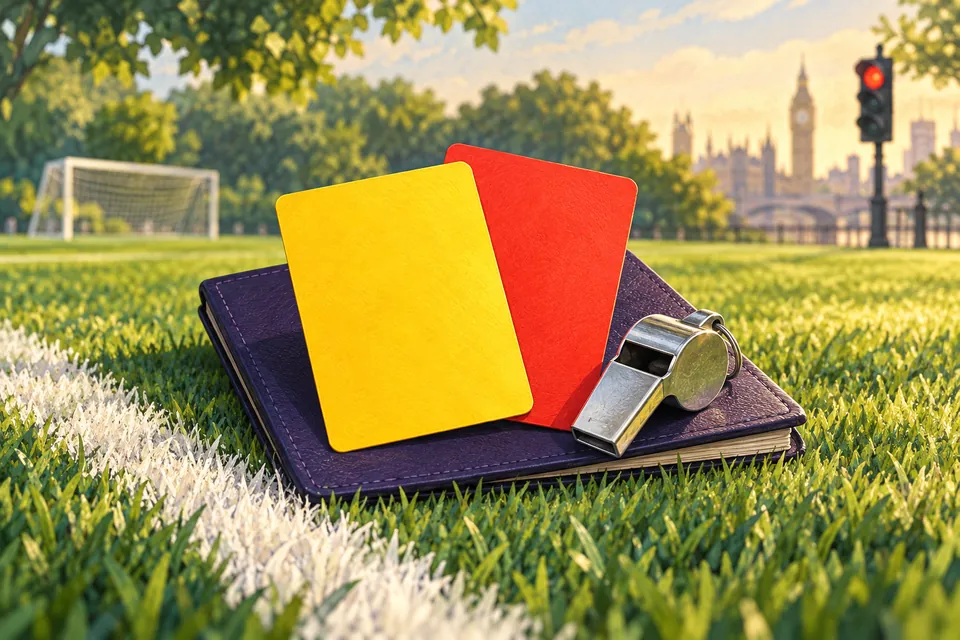
A traffic signal in the referee’s pocket
Football’s yellow and red cards were inspired by traffic lights: yellow communicates a caution; red communicates a sending-off. The colours give players and spectators a visible signal without relying on a shared language.
For such a dramatic little rectangle, the idea had a surprisingly ordinary starting point: a London road.
A message lost at Wembley
FIFA’s account traces the problem to the 1966 World Cup. During England’s quarter-final against Argentina, referee Rudolf Kreitlein sent off Antonio Rattín. They spoke different languages, and the argument left onlookers confused.
Ken Aston, who chaired the referees’ committee, wanted a clearer way to communicate decisions. In London, a traffic light changing from yellow to red gave him the idea.
The idea arrived before the cards
The cards were introduced at the 1970 World Cup in Mexico, four years after the tournament that inspired them.
That is the neat distinction for a quiz: 1966 for the inspiration, 1970 for their World Cup introduction. The colourful solution did not appear during the original argument.
Does yellow always come first?
No. Under the IFAB’s Law 12, a second caution in the same match is a sending-off offence. But serious foul play or violent conduct can bring a straight red; a player does not need an earlier yellow.
Curious about other sporting colours? Find out why tennis balls became yellow, or what the Olympic ring colours mean.