
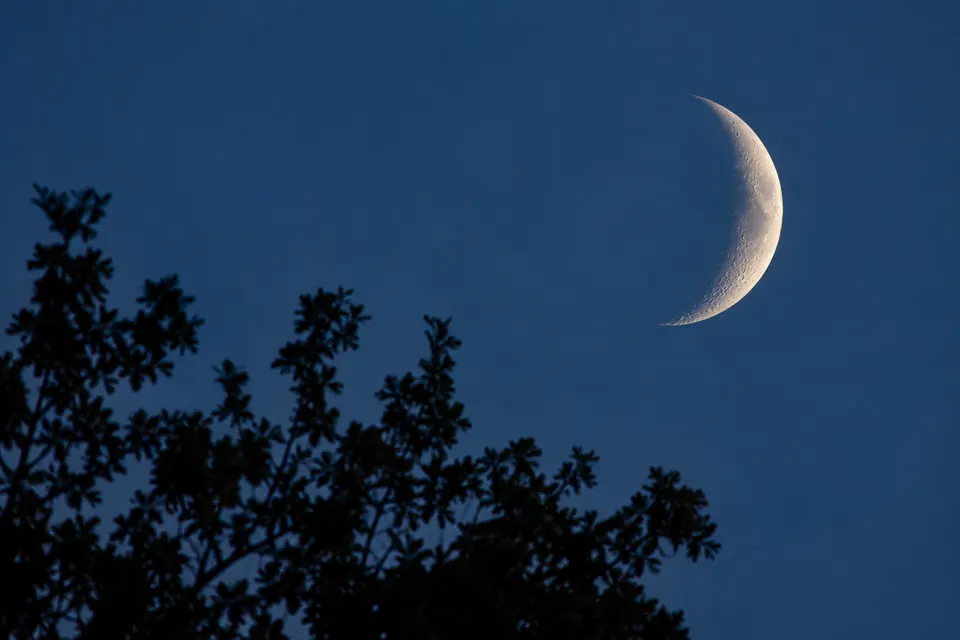
The Moon stays round
A crescent Moon looks like a thin smile. A full Moon looks like a bright circle. But the Moon has not grown a new piece or lost a bite.
The Moon stays round. It looks different because we see different amounts of its bright side.
The Moon does not make its own light like the Sun. Sunlight falls on it, and some of that light reaches our eyes.
Picture a ball beside a lamp
Hold a ball near a lamp. The side facing the lamp is bright; the other side is dark.
The Sun lights the Moon in a similar way: roughly half is sunlit. As the Moon travels around Earth, our view of that bright half changes.
Sometimes we see a lot of it. Sometimes we see only a thin slice. We call those different views the Moon’s phases.
Three names that can sound confusing
Waxing means the bright part we see is getting bigger from night to night. Waning means it is getting smaller. The Moon itself is not growing or shrinking.
First quarter is a trickier name. At that stage, about half of the Moon’s face looks bright. “Quarter” means it is about a quarter of the way through its cycle of phases—not that only a quarter looks lit.
What can we see?
| Name | What its face looks like from Earth |
|---|---|
| New Moon | Almost none of the bright half faces us |
| First quarter | About half of the face looks bright |
| Full Moon | Almost all of the face looks bright |
Is Earth’s shadow covering it?
Usually, no. The ordinary phases come from our changing view of the sunlit half.
Sometimes Earth does cast its shadow on the Moon. That special event is a lunar eclipse. It is different from the normal monthly phases.
Try noticing it for yourself
When you can see the Moon, draw its bright shape and write down the time. Look again on another clear evening.
Is the bright part bigger or smaller? You do not need to remember every phase name to start spotting the pattern.
The Moon may be in a different place or may not be visible at your chosen time. That is fine: look again another day.