
Choose one fixed point
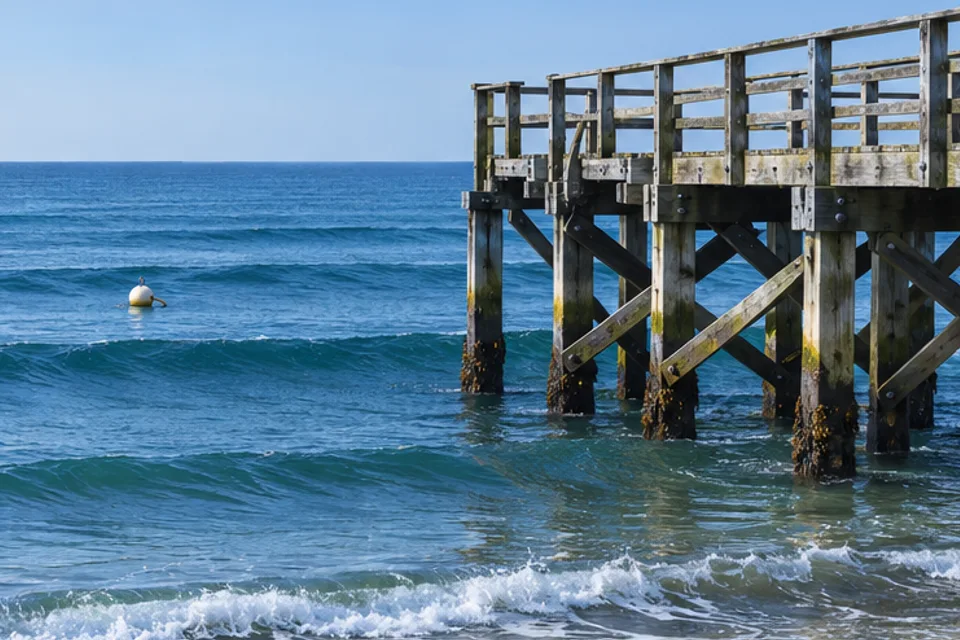
From a safe imaginary viewpoint, watch a single pile on a pier. A crest passes it at 0 seconds. The next three pass at 6, 12 and 18 seconds. Draw four marks on a timeline and count the gaps between them.
Count gaps instead of crests
Four crests give three intervals in this example. Divide the 18 seconds from first to last by those three intervals. The result is 6 seconds per wave. This interval is the wave period. It describes timing at a fixed point.
Separate timing and distance
Wavelength is the distance between two neighbouring crests at the same moment. Our stopwatch alone tells us the period, rather than the wavelength. If a floating object also travels steadily along the coast, a current may be carrying it while the crests pass.
For the underlying idea, read what starts an ocean wave. Explore more routes in the water cycle hub.
Read the source: NOAA Ocean Service · Waves and currents tutorial.