
From a puddle back to the air
The water cycle is the continual movement of water between the air, land, living things and oceans. The Sun supplies energy for evaporation and gravity pulls rain down and guides water over the land. There is no fixed starting point. Begin this route with a puddle, a shaded valley and a thundercloud.
- What is evaporation? Where a puddle goes. Practise: plan a fair drying test.
- Why does a cold glass get wet on the outside?. Practise: compare two glasses.
- How does fog form? A cloud at ground level. Practise: predict which road stays clear.
- How is hail formed? Ice inside a thunderstorm. Practise: trace a stone through a storm.
Two routes downhill
Imagine a shower over the edge of a town. Some rain runs down the street, through gutters and into a stream. Some sinks into the ground and may travel slowly enough to arrive well after the shower. Pick a spot beside the channel and ask which route the water would take to reach it.
- What is surface runoff? Follow the rain down a street. Practise: compare paving and grass.
- What is the water table? Read the ground below a well. Practise: compare two shallow wells.
Follow a watershed to a shared outlet or compare the channel with the low ground in the floodplain guide.
What moving water leaves behind
Water moving quickly can carry sediment away. Where it slows, some particles can settle. At a rocky step, differences between rock layers can even help decide where a waterfall forms. Use both clues to explain changes in the river without assuming every river behaves the same way.
- How do waterfalls form? The story behind a rocky step. Practise: predict where the ledge moves.
- Why do rivers turn brown after rain?. Practise: read two jars of river water.
Next try the worked example on river discharge to put a number on the amount of water passing you.
Three kinds of movement at the coast
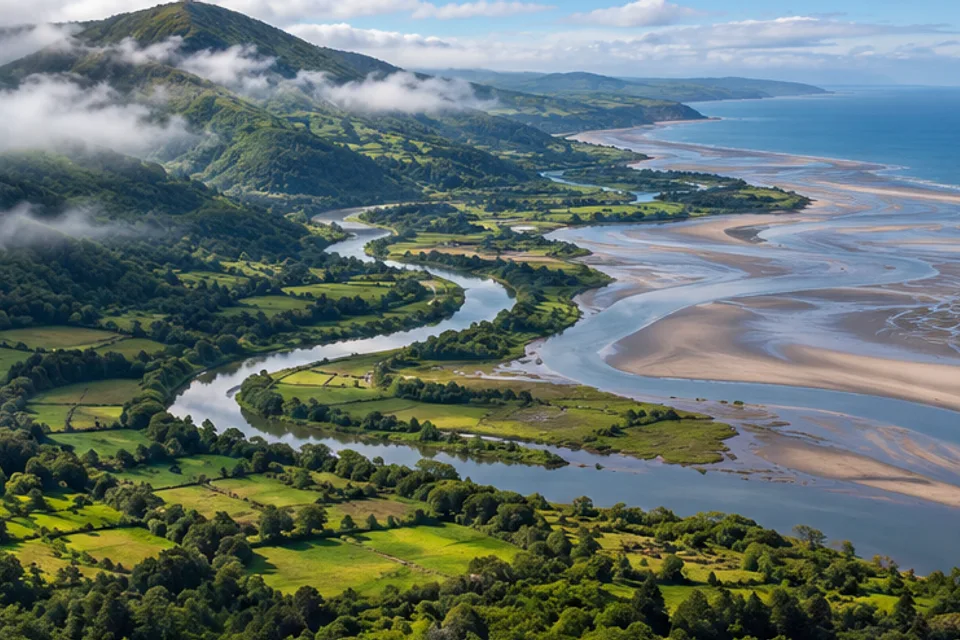
At the mouth of a river, its flow can meet tidal currents and short wind waves. A table of water heights helps you understand the changing tide. Watch the time between crests to describe the passing waves. Neither measurement by itself tells you the direction a floating object will drift.
- What causes tides? Why the sea level rises and falls. Practise: read a harbour prediction table.
- What causes ocean waves? Follow a swell to shore. Practise: time the crests beside a pier.
Work through all ten exercises in the BrainiLab Academy course. For the larger picture, see the US Geological Survey’s water cycle guide and NOAA’s example of a tidal-current prediction.