
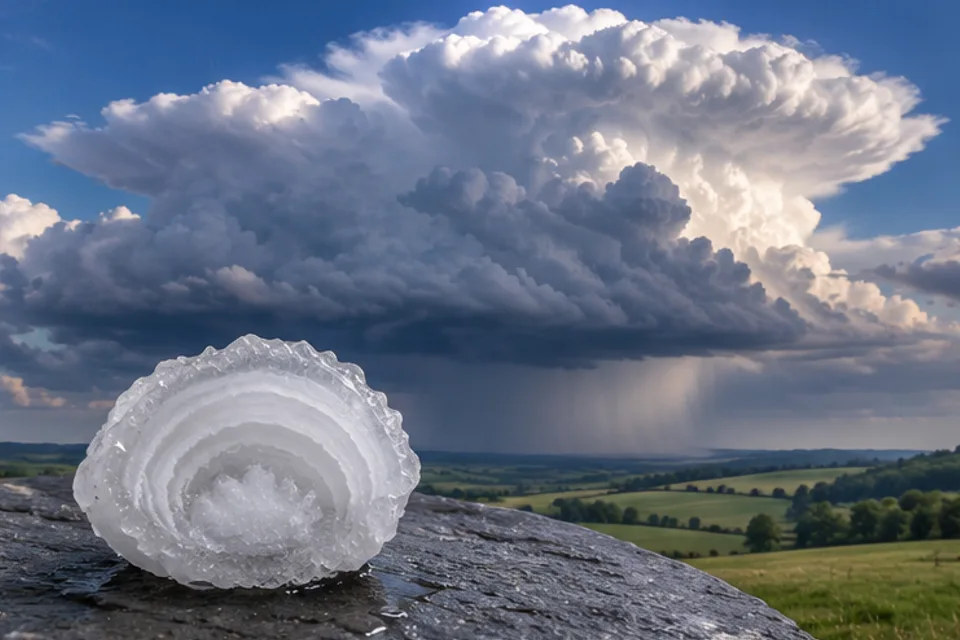
Place the ingredients
Draw an upward arrow inside a cloud to represent an updraught. Imagine that a small ice pellet is carried into an area with plenty of supercooled droplets. Extend your arrow horizontally into the cold, wet zone. Where the droplets strike the pellet and freeze, its ice coating grows.
Change just the route
Draw a second path that carries the pellet into a cloud region with very few liquid drops. The air is still cold, yet there is much less liquid available to add to the ice. That shows why temperature alone cannot explain how large a hailstone grows.
Let the ice leave the cloud
Now imagine a sideways movement taking the bigger pellet out of the strong updraught. Gravity pulls it down. Some of it can melt on its way into warmer air. The arrows are a simplified route through a storm; they are not a particular storm track.
For the underlying idea, read how hail grows. Explore more routes in the water cycle hub.
Read the source: NOAA National Severe Storms Laboratory · Hail basics.