
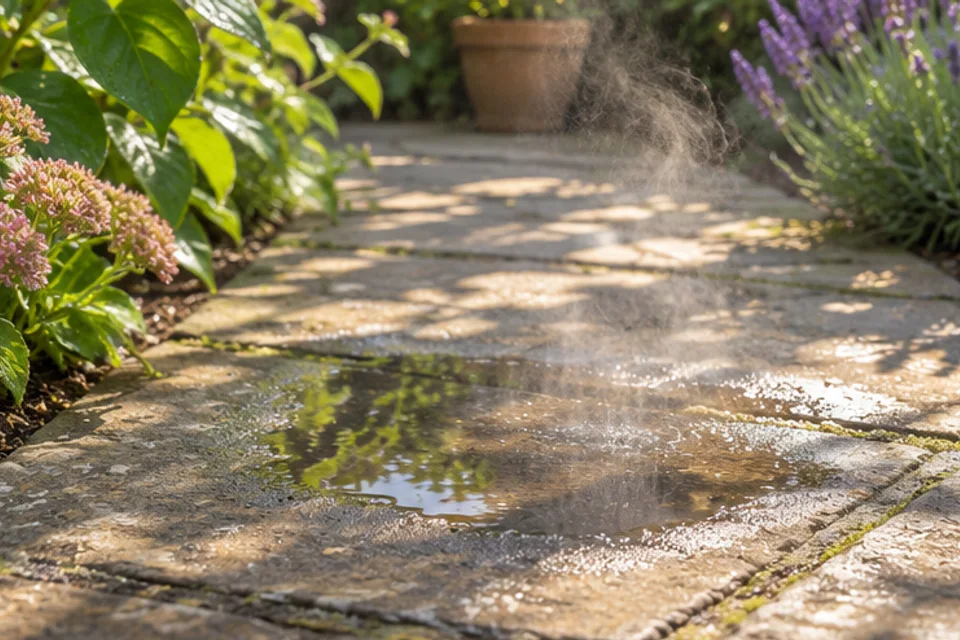
The water changes state
Evaporation happens when some molecules leave the surface of liquid water and join the air as water vapour. This can happen on a cool day. You do not need bubbles boiling through the liquid for molecules to escape at the surface. The puddle also might drain or soak away, so a shrinking puddle can have more than one cause.
Why a thin spread helps
Imagine spilling equal spoonfuls of water into a saucer and a narrow cup. The saucer lets much more of the water touch the air. If temperature, air movement and other conditions are alike, more of the liquid can evaporate in the same time from the wider exposed surface. A thin film on a stone has the same advantage.
When damp air slows it down
On a damp, still morning, the air immediately above the puddle can stay moist. Drier air and a moving breeze generally help water leave the surface faster. You can follow what happens when vapour changes direction in the process by looking at how condensation coats a cold glass.
Try the companion Academy exercise, or find your way through the water cycle from cloud to coast.
Read the source: US Geological Survey · Evaporation and the water cycle.