
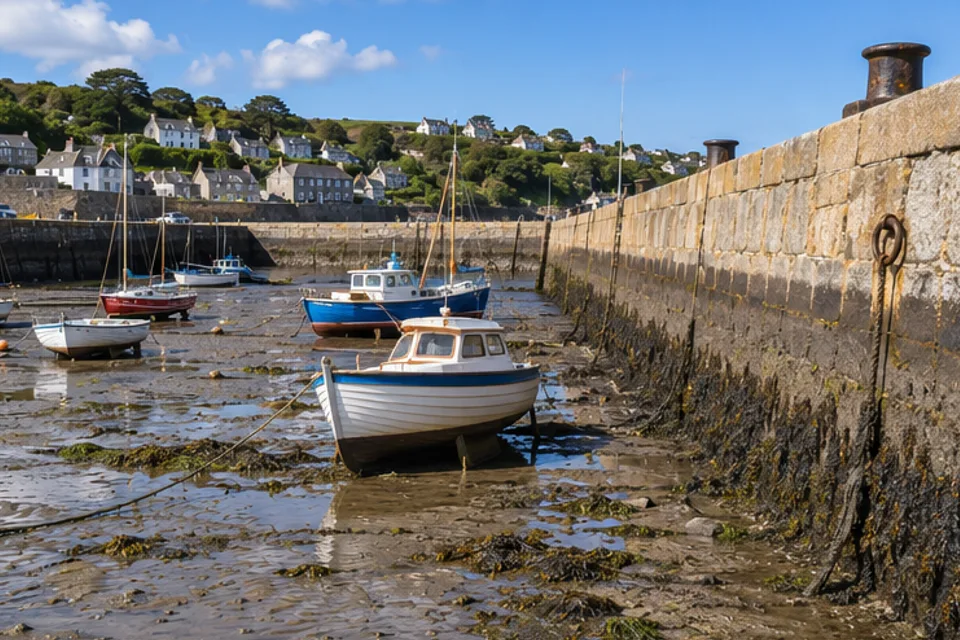
A change in water level
Tides are the regular rise and fall of water level, driven mainly by differences in the Moon’s gravitational pull across Earth. The Sun also contributes. As Earth rotates and the ocean responds, a place on the coast can see its water level rise towards high tide, then fall again.
Read the marks on a wall
Imagine standing beside a harbour wall in the morning and seeing a broad strip of dark, wet stone above the surface. A higher water level earlier could have wetted that stone. The difference between a high water level and the adjacent low is the tidal range. Nearby harbours can have different times and heights because coastlines and water depth affect how tides move.
Height has its own rhythm
Water level and the rate at which the water flows are separate measurements. A tidal current moves water as the tide changes, while a table of high and low tide tells you about height. Compare that long motion with the shorter, wind-driven what starts an ocean wave that can travel across the same surface.
Try the companion Academy exercise, or find your way through the water cycle from cloud to coast.
Read the source: NOAA Ocean Service · What are tides?.