
What does multiplying mean?
Imagine 3 bags with 4 sweets in each. You could count 4 sweets, then another 4, then another 4. That makes 12 sweets.
Multiplication is a shorter way to describe equal groups. The sign × means “times”. Three groups of four can be written as 3 × 4.
Now imagine eleven bags. Rather than counting every bag separately, we can count ten bags first, then the last bag.
Eleven bags with two sweets each
- Count the first ten bags. Each has two sweets. Count in twos: 2, 4, 6, 8, 10, 12, 14, 16, 18, 20.
- Open the last bag. It has two more sweets.
- Add them to the twenty. Twenty and two make 22.
That is why 11 × 2 is 22. The trick works because eleven is ten and one more.
Now put 34 sweets in each bag
The number is bigger, but the idea is exactly the same. We want the sweets in eleven bags, with 34 in each.
- Ten bags hold 340 sweets. To see why, split each bag into 30 sweets and 4 sweets. Ten lots of 30 make 300. Ten lots of 4 make 40. Together, that is 340.
- The last bag holds another 34. Add its 30 sweets first: 340 becomes 370.
- Add its remaining four sweets. The total becomes 374.
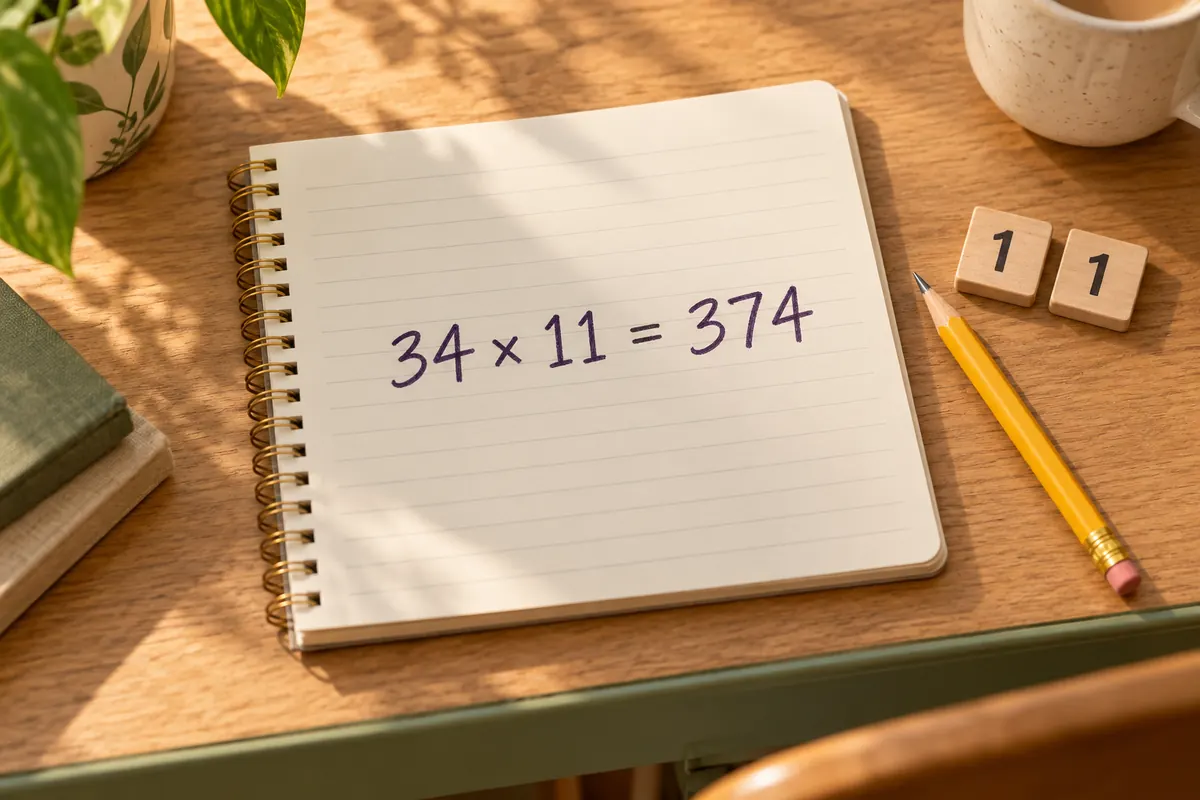
Written as one calculation, that is 34 × 11 = 374. The symbols are just a short way of writing the story about the bags.
A bigger example, with no new trick
What about eleven bags with 78 sweets in each?
- Ten bags hold 780 sweets.
- Split the last bag’s 78 sweets into 70 and 8. Add the 70 first. From 780, another 20 gets you to 800; the remaining 50 takes you to 850.
- Add the final eight. That makes 858.
There are faster shortcuts with digits, but you do not need them here. Counting ten equal groups and adding one more is enough.
Try eleven bags of three
Each bag holds three sweets. How many sweets are in eleven bags?
Walk me through it
Ten bags of three hold 30 sweets. The last bag adds another 3. Altogether, there are 33 sweets.
If you get stuck, draw the bags. Understanding why it works is more useful than rushing.
Ten bags, then the last bag
| Sweets in each bag | First ten bags | Last bag | Altogether |
|---|---|---|---|
| 2 | 20 | 2 more | 22 |
| 34 | 340 | 34 more | 374 |
| 78 | 780 | 78 more | 858 |
Next, discover what a percentage actually means, starting with a tray of one hundred squares.