
Percent means “out of one hundred”
Imagine a tray with 100 little squares. Colour in 50 of them. You have coloured half the tray.
You can say “50 out of 100”, or write 50%. The symbol % means “percent”. Fifty percent means fifty out of every hundred: half.
Colour in 25 squares instead and you have coloured one quarter of the tray. That is 25%. Colour all one hundred squares and you have 100%: the whole tray.
The tray does not have to contain 100 things
A percentage describes a share, not a fixed number of objects.
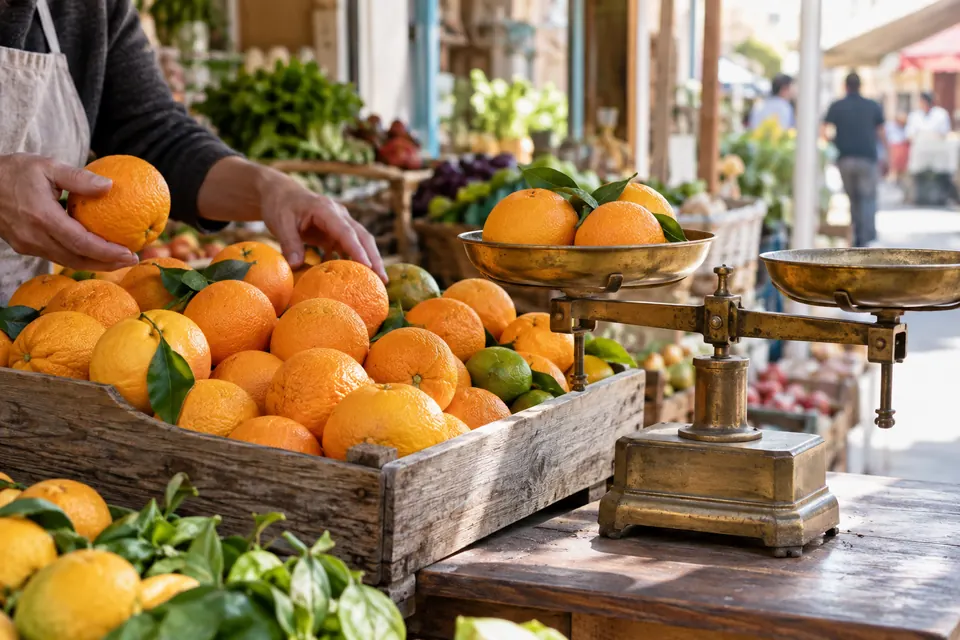
Half of 10 oranges is 5 oranges. Half of 80 oranges is 40 oranges. Both are 50% of the oranges you started with, even though the number of oranges is different.
So whenever you see a percentage, ask: a share of what? In our next examples, we will always start with 80 oranges.
Find 10% by making ten equal groups
On a tray of 100 squares, 10 coloured squares take up one of ten equal groups. That is why 10% means one tenth.
- Imagine sorting our 80 oranges into ten equal baskets.
- Each basket holds 8 oranges. Ten baskets of eight make eighty.
- One basket is one tenth of all the oranges. So 10% of 80 is 8.
In maths, sharing equally is called division. The sign ÷ means “divide”. You can write the basket step as 80 ÷ 10 = 8.
How do we find 15%?
Fifteen percent is ten percent and another five percent. Keep using the same original 80 oranges.
- We already found 10%: that is 8 oranges.
- Five is half of ten, so 5% is half as much. Half of eight is 4 oranges.
- Add the two shares: eight oranges and four oranges make 12 oranges.
So 15% of 80 is 12. We built the answer from two smaller, easier pieces.
One quarter is another useful starting point
We saw that 25% is one quarter. To find 25% of our 80 oranges, split them into four equal baskets.
Each basket holds 20 oranges. So 25% of 80 is 20.
If there are 20 oranges, how many is 50%?
Fifty percent means half. Split 20 oranges into two equal groups. Each group has 10 oranges.
Keep the original amount in view
| Share | Picture it as… | Oranges |
|---|---|---|
| 50% | Half of all the oranges | 40 |
| 25% | One of four equal groups | 20 |
| 10% | One of ten equal groups | 8 |
| 5% | Half as much as the 10% share | 4 |
| 15% | The 10% share plus the 5% share | 12 |
You do not need to memorise the whole table. Start with half, then practise making ten equal groups. The other pieces can come later.