
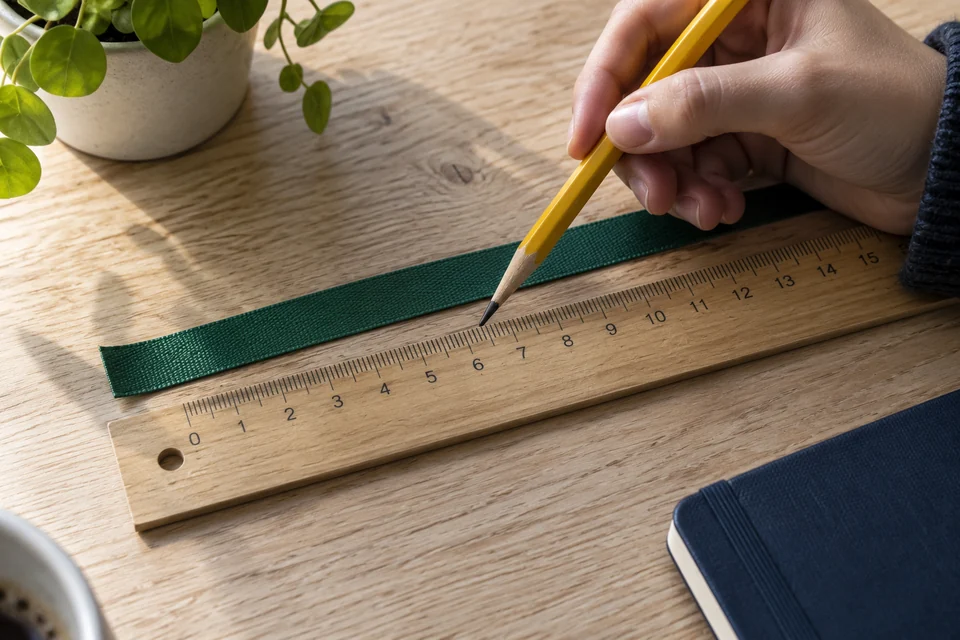
One ribbon, ten equal pieces
Imagine a ribbon that is exactly one metre long. Cut it into ten equal pieces. Pick up one piece. You are holding one tenth of the original ribbon.
You can write that fraction as 1/10. You can also write it as 0.1. These are two names for the same length.
The dot is called the decimal point. Here, the zero on its left means there are no complete metres. The 1 just after the dot counts tenths of a metre.
Put five little pieces together
Line up five of your ten pieces. They reach halfway along the original ribbon.
- As a fraction of the whole ribbon, that is 5/10.
- As a decimal, it is 0.5.
- In everyday words, it is one half.
Read 0.5 as “zero point five”. The point does not mean “add” or “multiply”. It separates the whole-number part from the smaller parts.
Colour a little, then a little more
Draw a square divided into ten equal columns. Shade five columns: half the square is coloured, so the shaded amount is 0.5.
Divide each column into ten equal little squares. Your shaded half now covers 50 of the 100 squares: 0.50. The drawing changed its divisions, not its shaded amount.
A tenth can be split again
Cut each of the ten ribbon pieces into ten smaller, equal pieces. You now have 100 tiny pieces altogether. Each is one hundredth of the original ribbon.
One hundredth is written 0.01. The first place after the point counts tenths; the second counts hundredths.
| Number | What it means |
|---|---|
| 0.1 | One tenth |
| 0.01 | One hundredth |
| 0.25 | Two tenths and five hundredths: 25 hundredths altogether |
Shade 25 of the 100 little squares on paper. You have coloured one quarter of the whole square.
Why 0.5 and 0.50 match
Five columns contain fifty tiny squares. So five tenths and fifty hundredths cover the same amount. That is why 0.5 equals 0.50.
The extra zero at the end does not add any length. But its position matters: 0.05 means only five hundredths. That is much smaller than five tenths. Compare five shaded little squares with fifty to see the difference.
If this feels familiar, you have already met the idea in different fractions that describe the same amount.
What if there is a whole ribbon too?
Take one complete metre of ribbon, then add three of the tenth-metre pieces. You have 1.3 metres: one whole metre and three tenths more.
For now, that is enough. Locate the point, look at each place, and think about the size of the pieces. You do not need a long calculation to understand a decimal.
For the full picture, explore seven friendly starting points for basic arithmetic.