
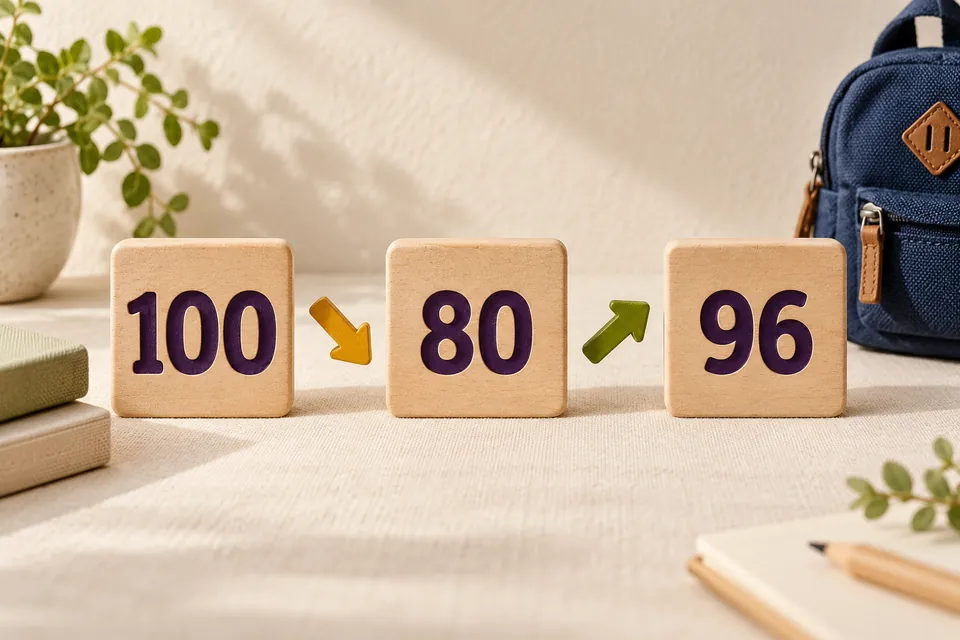
The backpack that does not quite bounce back
A 20% decrease followed by a 20% increase leaves 96% of a positive starting amount. The percentages use different bases, so they do not cancel. Cambridge’s NRICH explores this changing-base puzzle.
Imagine a backpack priced at $100. A 20% reduction removes $20, leaving $80. Later, its price rises by 20%. Surely the original price returns? The backpack has other plans.
How do you calculate percentage change?
For a positive original amount, calculate (new amount − original amount) ÷ original amount × 100%. A positive result is an increase; a negative result is a decrease. OpenStax explains comparing the change with the original amount.
From 100 to 80, the change is −20: −20 ÷ 100 × 100% = −20%. For the next step, 80 becomes the original amount. From 80 to 96, the change is 16: 16 ÷ 80 × 100% = 20%.
What increase would really get you back?
To get from 80 back to 100, you need an increase of 20. Compare that increase with 80: 20 ÷ 80 × 100% = 25%.
So a 20% drop needs a 25% rise to reverse it. Our fictional backpack does return to $100—just with a different percentage on the return journey.
Before combining percentages, write down each starting amount. The two percentage signs may match perfectly while quietly referring to different wholes.