
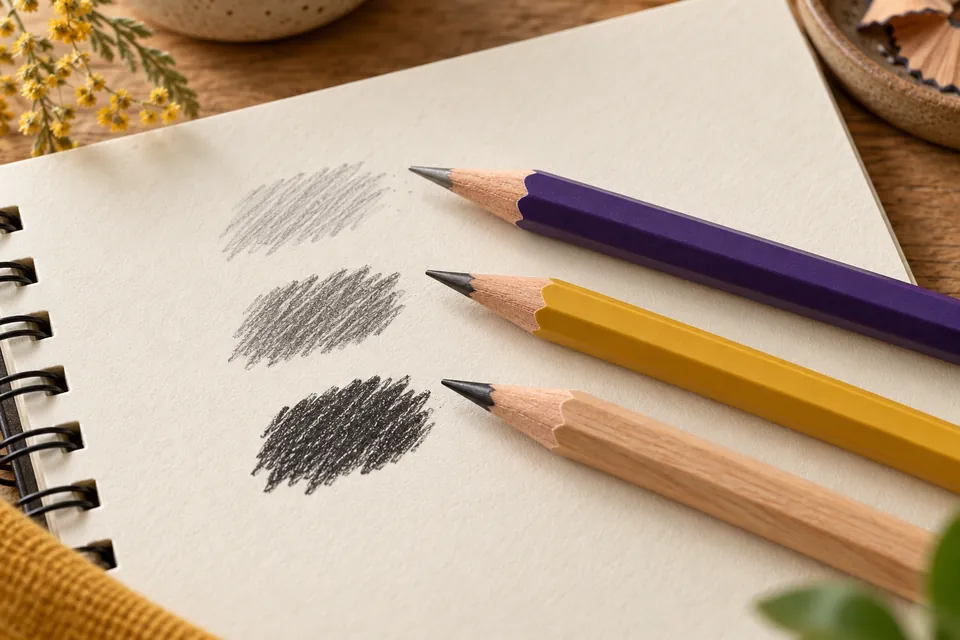
The letters are doing a small job
H means hard, B means black, and HB means hard black. In the usual graphite pencil scale, H grades are harder, B grades are softer and darker, and HB sits between them. Pencil maker STAEDTLER explains the letters and grades.
A pencil looks like such a simple object that its tiny code can seem oddly serious. You wanted to draw a cat, not choose a spacecraft component. Fortunately, the code is just a clue to the kind of mark it makes.
Why 2H and 2B go in different directions
A larger number before H means a harder grade: 2H is harder than H. A larger number before B means a softer grade: 2B is softer than B.
So the number is not a quality score. A 4H pencil has not beaten a 2B pencil in a competition. They do different jobs. Softer grades help with dark shading; harder grades suit lighter, finer work. STAEDTLER groups its grades by writing and drawing uses.
What changes inside the pencil?
In a traditional graphite pencil, the core contains graphite and clay. Graphite leaves the familiar grey-black mark. According to STAEDTLER’s manufacturing explanation, changing their proportions changes the hardness: more clay makes a harder core; more graphite makes it softer and blacker.
The barrel colour can be cheerful, but it does not tell you the grade. The little H or B is the useful clue when two ordinary pencils leave surprisingly different marks.
Try three patches on scrap paper
If you have an H, an HB and a B pencil, shade a small patch with each using similar pressure. Compare the marks. A darker patch does not automatically mean a better pencil; it might simply be closer to the effect you want.
Remember the two directions: more H, harder; more B, softer. You can return to drawing the cat. Its dramatic shadow may need a different pencil from its first faint outline.
For another clever detail on a desk, read how a slipping bookmark helped inspire Post-it Notes.