
Try it with a paper shape
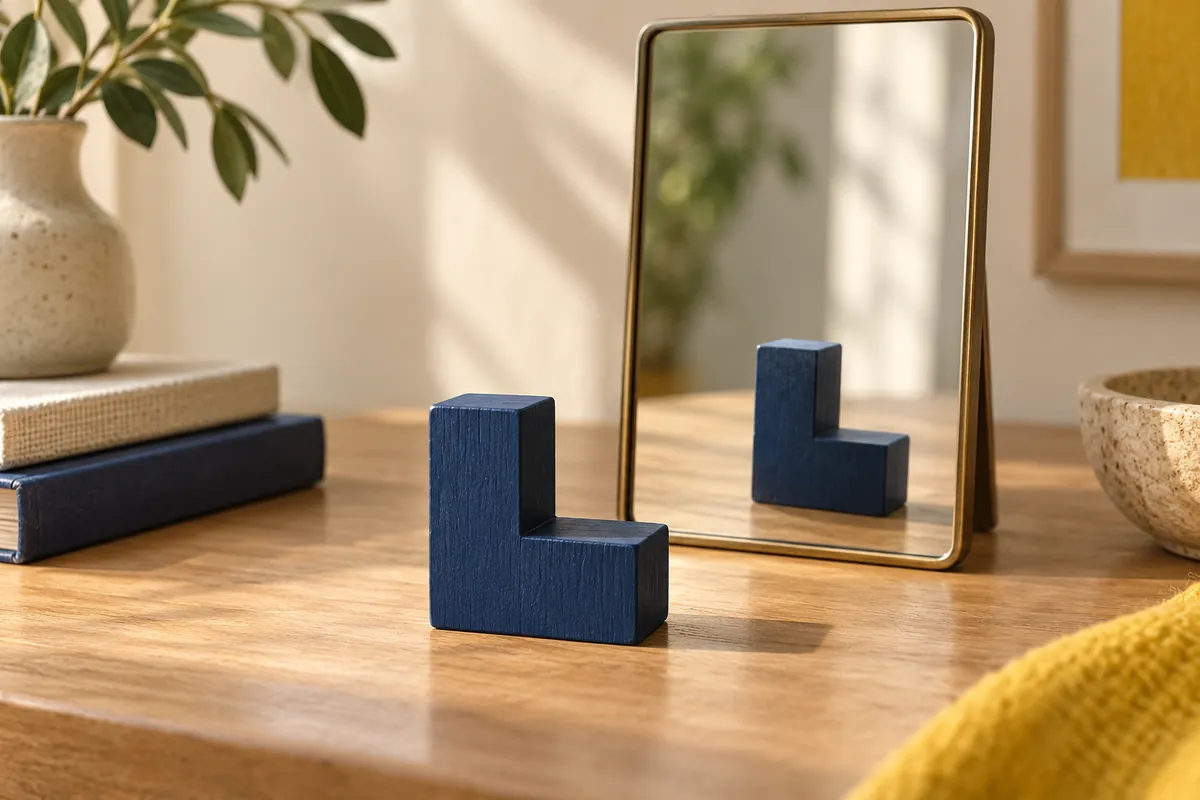
Cut an L shape from paper. Turn it a quarter-turn on the table. Its size and outline stay the same, but it points a different way. This is a rotation.
Now imagine looking at it in a mirror. The bend changes sides. That is a reflection. A shape with a clearly marked corner makes the difference easier to notice than a plain circle would.
Try it yourself
Draw an L on paper and mark one corner with a dot. Turn the paper a quarter-turn on the table. Four quarter-turns return it to its starting position. Then hold it beside a mirror to compare a reflection.
Follow the small dot as well as the outside edge. The dot is attached to the shape, so it moves with it. Even if the outside shape looks the same, the dot helps you see how it moved.
Use the direction in the question
A clockwise quarter-turn follows the direction of clock hands. A half-turn rotates through two quarter-turns. A full turn is four quarter-turns. Turns can also be measured in degrees: a full turn is 360 degrees.
For a reflection, imagine a line where the mirror sits. A vertical line runs up and down: a reflection across it switches left and right. A horizontal line runs across the page: a reflection across it switches top and bottom.
Follow one marked corner
Look for a short arm, a long arm and a marked corner. Track where each feature moves. If only one feature matches your prediction, you may have turned the shape the wrong way or imagined a reflection.
Some shapes, such as a square without a mark, can look unchanged after certain movements. That does not mean no movement happened. A dot or a clearly different corner makes it easier to tell what happened.