
BrainiLab Academy · Numbers & logic
Patterns and reasoning
Seven short lessons: find patterns, turn shapes, combine rules, count overlaps and discover why a fair coin does not remember earlier flips. Optional quizzes included.
Start learning →
What you’ll explore
Find a repeating unit, test a number rule and change your viewpoint. Then combine conditions, check conclusions and count shared members without counting them twice.
Finish with a coin that seems to be on a streak. Can earlier outcomes tell you what must happen next? Follow the assumptions and try the small examples at your own pace. Short quizzes are optional.
One discovery at a time
Your lessons, step by step
- 1
 Read →
2 min read · Quick quiz
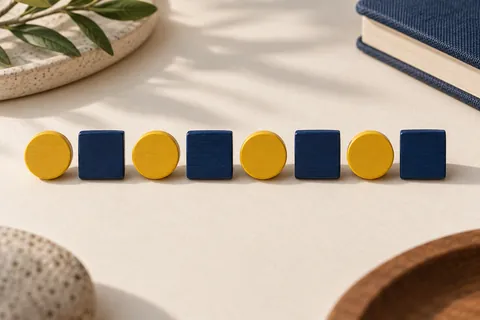
How to spot a repeating pattern
Find the repeating unit before predicting the next item.
Ready when you are - 2
 Read →
2 min read · Quick quiz
Number patterns: check every jump
Check a proposed number rule against every step.
Ready when you are - 3
 Read →
2 min read · Quick quiz
Turning or flipping a shape: what changes?
Distinguish turning a shape from reflecting it.
Ready when you are - 4
 Read →
2 min read · Quick quiz
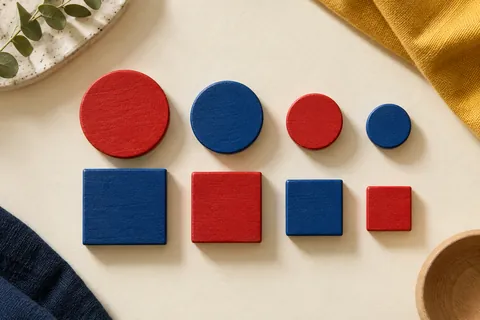
What is the difference between “and” and “or”?
Sort objects by two rules at once.
Ready when you are - 5
 Read →
2 min read · Quick quiz
Is it certain, or just possible?
Identify what must follow from the stated facts.
Ready when you are - 6
 Read →
2 min read · Quick quiz
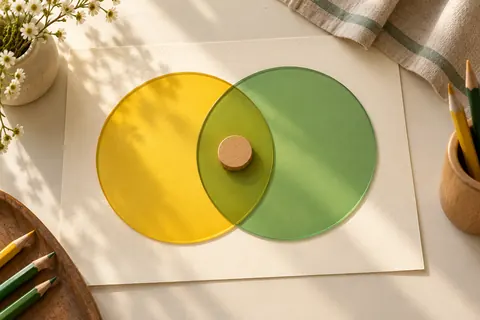
Venn diagram examples: who wants both pizza toppings?
Read separate Venn-diagram regions and avoid double counting shared members.
Ready when you are - 7
 Read →
2 min read · Quick quiz
Coin flip probability: can a coin remember five heads?
Distinguish the probability of a whole sequence from the next independent flip under a fair-coin model.
Ready when you are
A few words worth knowing
- Repeating unit
- The smallest block repeated to make a pattern.
- Reflection
- A flip across a mirror line.
- Intersection
- The objects belonging to both groups.
- Deduction
- A conclusion that follows from the facts and rules given.
- Union
- The members of either group or both, with each counted once.
- Independent events
- Events where knowing one occurred does not change the probability of the other.
Curious to dig deeper?
- Math is Fun — Number Patterns
- Math is Fun — Rotation
- Math is Fun — Sets and Venn Diagrams
- OpenStax — Understanding Venn Diagrams
- OpenStax — Set Operations with Two Sets
- University of Cambridge NRICH — Independence and Dependence
- OpenStax — Introductory Statistics 2e: Independent and Mutually Exclusive Events
Follow the sources, explore a little further, or tell us if something needs a correction. Suggest a correction.