
Two circles can save a pizza order
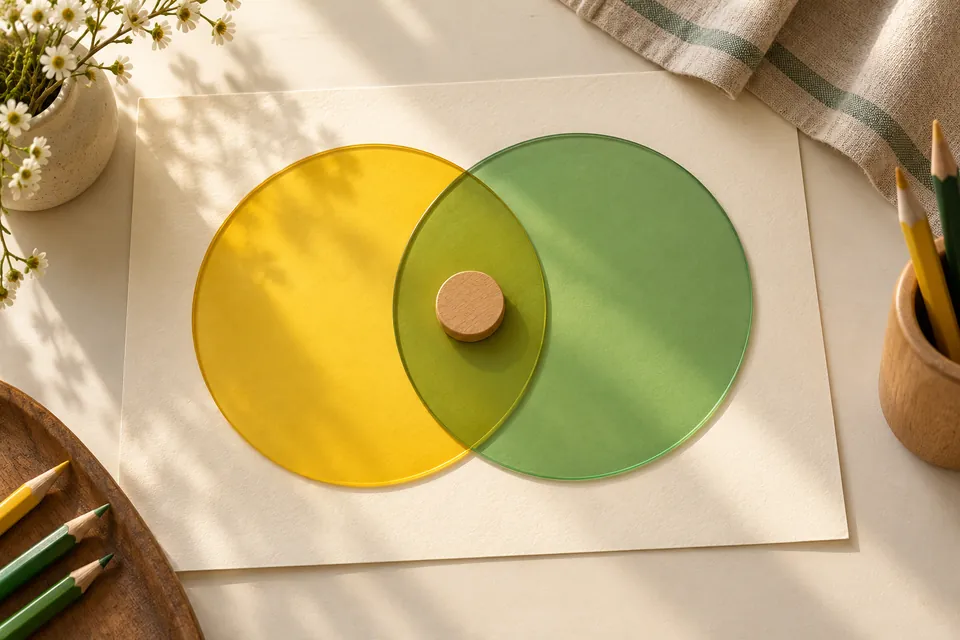
A Venn diagram shows how groups relate. In a two-circle example, the overlapping middle holds the things that belong to both groups. OpenStax explains the diagram’s role in making those relationships visible.
Imagine ordering pizza for five friends. One circle means “likes mushrooms”; the other means “likes olives”. A friend can belong to either group, both groups or neither. The circles describe preferences, not separate tables to sit at.
Maya is not two people
Here is a small Venn diagram example you can sketch:
- Mushrooms: Maya, Leo and Sam.
- Olives: Maya and Noor.
- Neither: Tess.
Put Maya in the shared middle, Leo and Sam in mushrooms only, and Noor in olives only. Tess stays outside both circles, inside a box representing all five friends.
The middle is the intersection: the members both groups share. Maya still gets one place in the drawing. She has two preferences, not a spare head.
Why 3 + 2 does not make five topping fans
Three friends like mushrooms and two like olives. Add those totals and you count Maya twice. To find everyone who likes at least one topping, count her once:
3 + 2 − 1 = 4 friends.
This combined group is the union. OpenStax’s counting rule subtracts the overlap after adding the two group totals.
If you already wrote the separate regions instead—two in mushrooms only, one in both and one in olives only—add 2 + 1 + 1. Do not subtract Maya again. The wording matters, just as it does with “and” and “or”.
Do not forget the friend outside
Tess has not vanished because she dislikes both toppings. The rectangle sets the whole group being considered; here that is five friends. Four like at least one topping, leaving one who likes neither.
For your next sketch, try “likes tea” and “likes coffee”. Label the circles before placing anyone. Read each region once, and the little picture will keep your guest list honest.