
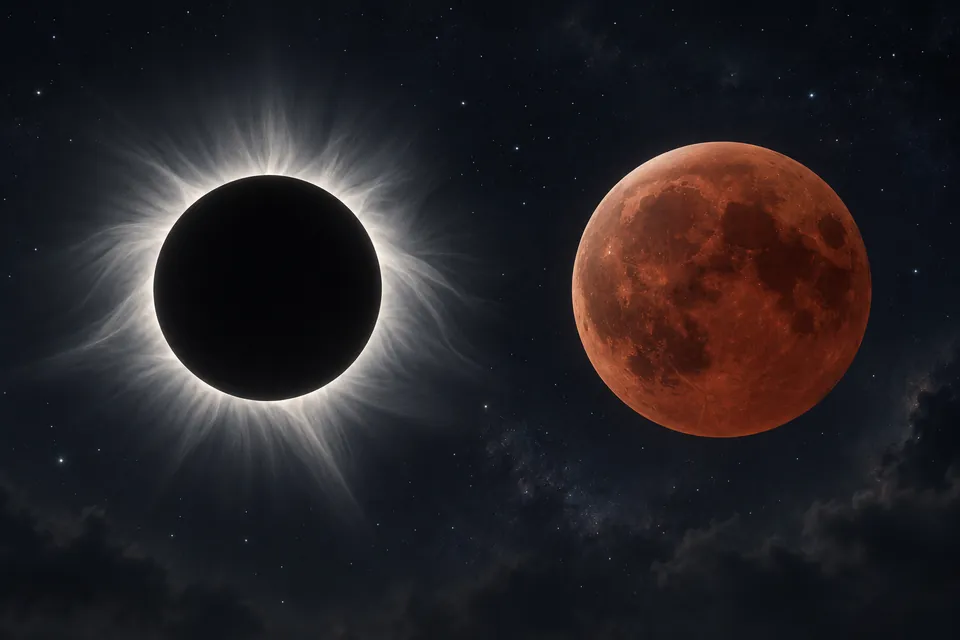
Same cast, different object in the middle
In a solar eclipse, the Moon passes between the Sun and Earth. In a lunar eclipse, Earth passes between the Sun and Moon. The difference is who blocks the sunlight—and where the shadow falls.
Think of three objects lined up for a shadow show. Move the middle one and the story changes. The word solar points to the Sun; lunar points to the Moon.
One hides the Sun; the other dims the Moon
During a solar eclipse, the Moon can cover some or all of the Sun’s face from a particular place on Earth. The line-up is Sun → Moon → Earth, at new Moon.
During a lunar eclipse, the Moon moves into Earth’s shadow. The line-up is Sun → Earth → Moon, at full Moon. NASA’s eclipse guide explains both arrangements.
A totally eclipsed Moon can look reddish. Some sunlight reaches it after travelling through Earth’s atmosphere, which scatters more of the blue light. The Moon has not switched on a red lamp.
Why is there no eclipse every month?
There is a new Moon and a full Moon each month, so why not two eclipses?
The Moon’s orbit is tilted relative to Earth’s path around the Sun. Most months, the alignment misses: the Moon passes above or below the Sun in our sky, or above or below Earth’s shadow. NASA explains this geometry.
That is also why ordinary Moon phases are not little eclipses. Phases come from our changing view of the Moon’s sunlit half.
A small trick for remembering
Ask: “What is in the middle?” Moon in the middle: solar eclipse. Earth in the middle: lunar eclipse. You do not need a calendar of eclipse dates to understand the difference.
You can explore shadows with a lamp and a ball indoors. Do not use the Sun for this experiment. If you plan to watch a solar eclipse, follow NASA’s viewing-safety guidance; ordinary sunglasses are not safe solar viewers.