
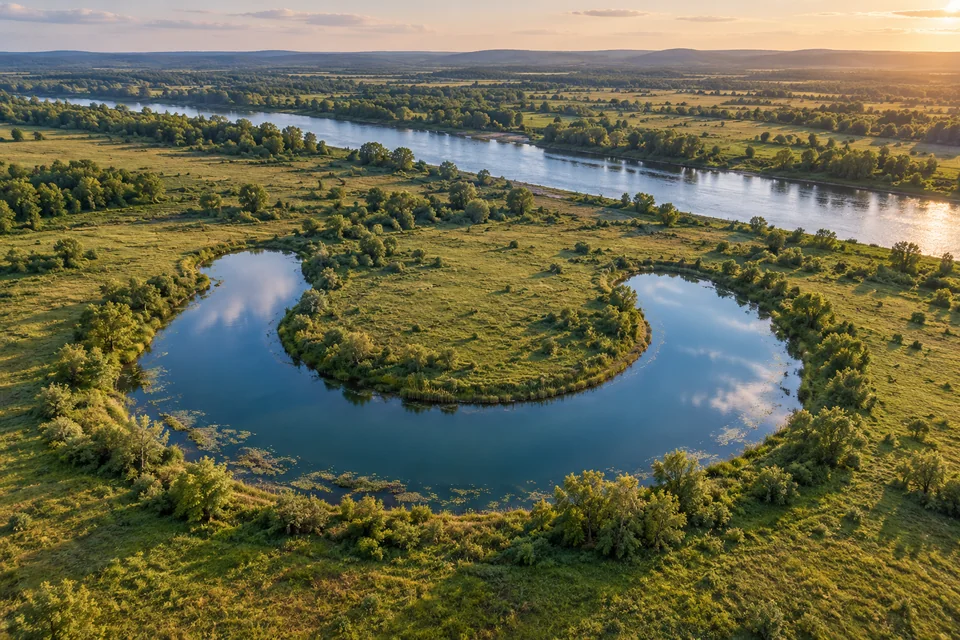
A bend with a past
An oxbow lake is a curved lake formed when a river cuts off one of its own bends and takes a shorter route. That horseshoe of water is a little piece of the river’s past.
Imagine a path that loops around a field. A new shortcut crosses the narrow neck of the loop; the long way round is left behind. Rivers can make a similar change.
How does an oxbow lake form?
A river bend, or meander, can grow as water wears away its outer bank and deposits sediment on its inner bank.
When the river breaks through the narrow neck, it can bypass the loop. The abandoned bend becomes a separate lake. The National Park Service explains this cutoff process.
Where did the odd name come from?
An oxbow is a U-shaped part of a yoke, the frame used to harness oxen. The lake borrows that curved shape’s name. No oxen need to be swimming in it.
A lake is not always forever
Over time, sediment and dead plant material can fill the old bend. It may become wetland and eventually dry out. USGS satellite images of Bolivia’s Mamoré River show a floodplain dotted with these former loops.
At the other end of a river’s journey, another meeting takes place: fresh water meets the sea in an estuary.