
The human past in material traces
Archaeology studies the human past through material remains: the objects, structures and other traces people leave behind. Its subject can be an ancient settlement or a much more recent building. “Archaeological” does not simply mean extremely old.
The Society for American Archaeology’s introduction explains that broad scope. A tool can reveal how something was made; a building can preserve how a space was arranged. Animal bones and plant remains can also help archaeologists investigate human lives and surroundings.
Finding a striking object is a beginning. The larger question is what it can tell us about people, with evidence to support the interpretation.
One fragment, more than one story
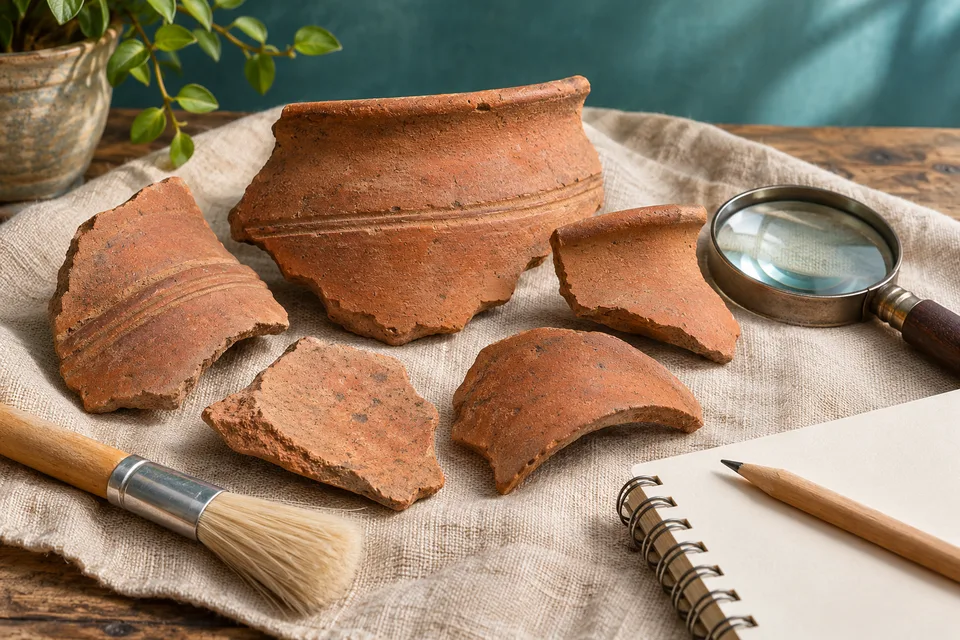
Imagine a broken piece of pottery. This is an invented example, not a description of a real excavation. Its shape and material are clues. Now imagine three places where it might be found.
- Beside a hearth: it might contribute to a question about activities around that hearth.
- In a rubbish pit: the question might concern what people discarded, together with the other material in the pit.
- In recently mixed garden soil: it may have been moved away from the place where it was used or first buried.
None of those positions proves what the pot held or who owned it. They show why recording the surroundings matters. An object’s position and its relationships with other finds and deposits form its context. The Archaeological Institute of America’s glossary explains that term alongside artefact, feature and ecofact.
An artefact is a portable object made, changed or used by people. A feature is a less portable trace, such as a pit or hearth. An ecofact, such as a seed, can supply information about past environments or human activity without itself being a manufactured object.
Layers give an order, not an automatic date
In an undisturbed sequence of deposits, a layer resting above another was laid down later. That relationship can put events in order. It does not, by itself, supply a calendar year.
The qualification matters. A later pit can cut through earlier layers. Material can be moved, and a deep find is not automatically older than every shallower one. Archaeologists examine how deposits and cuts relate rather than treating depth as a date.
Buckinghamshire’s guide to relative dating shows how these relationships build a sequence. Think “this happened before that” rather than “this must be from a particular year”. Other evidence is needed to connect that order to dates.
More than digging
Excavation is one method, rather than the whole subject. Archaeologists can also investigate through surveys and by re-examining material already held in collections. The SAA’s overview of archaeological methods describes that work beyond a new dig.
Archaeology and palaeontology have different central questions. Palaeontology studies past life through fossils; archaeology focuses on the human past. That does not mean archaeologists never examine bones, plants or fossils. Their question concerns the evidence those remains can offer about people.
Material traces can also be compared with written and visual records. Our guide to historical sources starts with a useful habit: separate the detail you can see from what you infer. The Rosetta Stone offers a famous example of an object whose writing and physical form both matter.
For the different processes that preserve past life, follow how fossils form. A fragment becomes more useful when you can explain both what survives and which question you are asking of it.