
What counts as a historical source?
A historical source is something you use to answer a question about the past. A primary source provides direct evidence for the period or event you’re studying. A secondary source explains or interprets evidence.
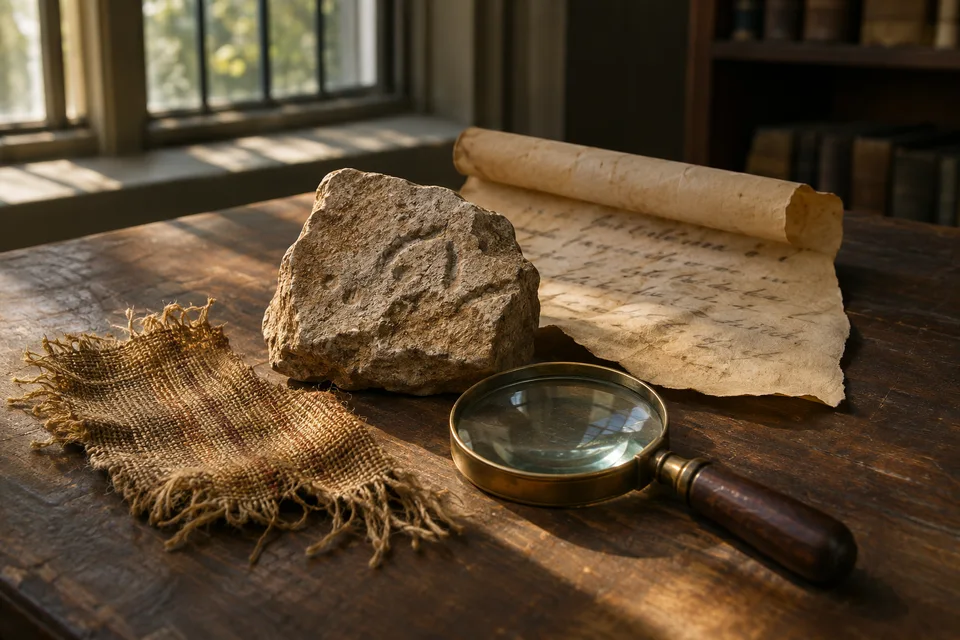
A building, a handwritten record and a piece of cloth can all supply evidence. Decide what you want to find out before you decide what kind of source you have. The Library of Congress introduction to primary sources starts with original objects and documents and asks readers to look closely before drawing conclusions.
Separate what you see from what you infer
Take one object, image or document and write three short lines. This gives you something you can compare with a second source. The US National Archives’ analysis worksheets offer related questions for objects, maps, pictures and written documents.
- I can see: name a detail you can point to, such as a seam, a seal or a different script.
- It might mean: explain what you think the detail suggests and why.
- I would check: choose another object, record or museum note that could confirm or change your reading.
Imagine an old photograph of a town square with a banner across it. You can say a banner was there for the photograph. A celebration is one possible explanation. The caption, a dated programme or a local newspaper would help you test it.
The same object can answer different questions
Imagine that photograph has a caption added decades after it was taken. If you want to know which shops faced the square, examine the shopfronts. If you want to know how a later exhibition described the town, examine the caption. The caption is direct evidence of how the exhibition presented the past, even if it is a later interpretation of the photograph.
Before taking two captions as independent confirmation, see where each one got its information. If both copy the same archive note, you still have one account. Compare it with a map or another photograph taken from a different angle. You don’t need every source to agree; a disagreement can tell you what to check next.
Read the words and the material
Look at what the maker wrote and how the object was made. The two clues can answer different questions.
- The Rosetta Stone records a decree in three scripts. The British Museum’s gallery guide identifies them. Ask which version scholars could already read and how it gave them something to compare.
- The Bayeux Tapestry tells a story in pictures and words. The Bayeux Museum identifies wool stitches on linen, so the technique gives you a clue the familiar name hides. Ask how the makers chose to tell the story.
- Magna Carta is a reminder to check which version you are looking at. The US National Archives displays a 1297 copy and explains how the charter was reissued after King John’s agreement of 1215. A date on a label can tell you which stage of the story your object belongs to.
Ask what the objects were made to do
Look for the shape that does the work, then compare it with the object’s surroundings. A museum description can help you distinguish what survives from what has been reconstructed.
- The hornless Viking helmet gives you an object to compare with the familiar costume. The Museum of the Viking Age’s record explains where the helmet was found and what survives.
- Gargoyles show how a detail can reveal a practical purpose. Follow the route the rain would take, and use it to distinguish a working waterspout from a decorative figure.
- Roman concrete takes you from the visible building to what survives inside a piece of it. Compare a material clue with an experiment that tests a possible explanation.
Read a place alongside the records
A plan or a map can tell you which parts of a site were connected. A surviving wall can show where a boundary ran. Records and accounts add context for why people built it and how it was used.
- The Egyptian pyramids make more sense when you look for the temples and other structures around the tombs.
- The Colosseum gives you a different question to try: what can you infer about the spectators from the arrangement of an arena?
- The Berlin Wall is a good case for reading a map before drawing a conclusion. Follow the boundary and ask whom it was designed to stop.
Check the question before deciding what counts
The Mona Lisa works for two different investigations. Look closely at the painting if you want to study its visual details. If you are asking how news of the theft spread, look for accounts from that time. A later article that compares the coverage can help you interpret those accounts.
Pick any example above and give someone else your three lines. Can they point to the same detail? If they suggest a different explanation, agree on one thing you would check next.
Try the same question on two examples
Pick the Colosseum and Magna Carta, and ask: ‘Who was the maker expecting to use this?’ With the arena, work from a plan and look for entrances and routes. With the charter, start with the date and ask who issued that version and whom it addressed. A plan and a charter need different reading methods, even when you start with the same question.
Finish with one sentence you can defend. ‘This entrance connects to this part of the arena’ is narrower than ‘everyone used this entrance’, and easier to check. If you can’t yet support the wider claim, write down what evidence you would need rather than filling the gap with a guess.