
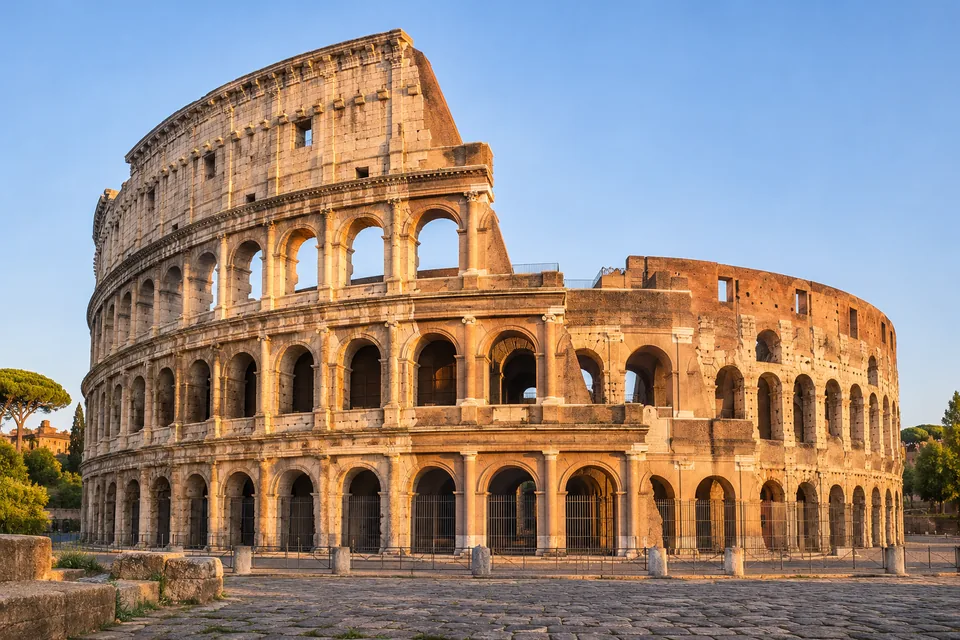
An arena for a crowd
The Colosseum was built as a vast public arena for spectacles, including gladiatorial contests and animal hunts. The emperors of the Flavian dynasty commissioned it in first-century Rome.
The archaeological park describes those popular spectacles as central to the amphitheatre’s ancient use. Its curved tiers gathered a large audience around the space where the action took place.
For a closer look at what entrance routes can tell you about crowds, try the arena example in our guide to interpreting historical sources.
Where a lake had been
Emperor Vespasian chose a site previously occupied by an artificial lake in Nero’s palace complex, the Domus Aurea. Rome’s official tourism account identifies that earlier lake.
That change of use is worth picturing: a place associated with an emperor’s palace became the site of an enormous venue for crowds. The location is part of the building’s story, alongside its arches.
Two emperors, two dates
King’s College London’s Art of Making project dates the beginning under Vespasian to 70 CE and the inauguration by his son Titus to 80 CE.
So the emperor who started the project and the one who opened it were different people. To place those dates on a longer timeline, try our guide to centuries.
The name came from next door
The building’s original name was the Flavian Amphitheatre. The archaeological park explains that the familiar name Colosseum came from a colossal statue nearby.
Its structure used several materials. The Art of Making account describes tuff, brick-faced concrete and an exterior faced with travertine. For a different question about Roman building materials, explore why some Roman concrete lasts so long.
That guide follows evidence from particular materials and experiments; it does not claim that every surviving Roman wall behaves in the same way.