
A feel for the world
Cats have whiskers to sense what is happening close to their bodies. These specialised hairs pick up contact and movement, helping a cat judge nearby objects and find its way in dim light.
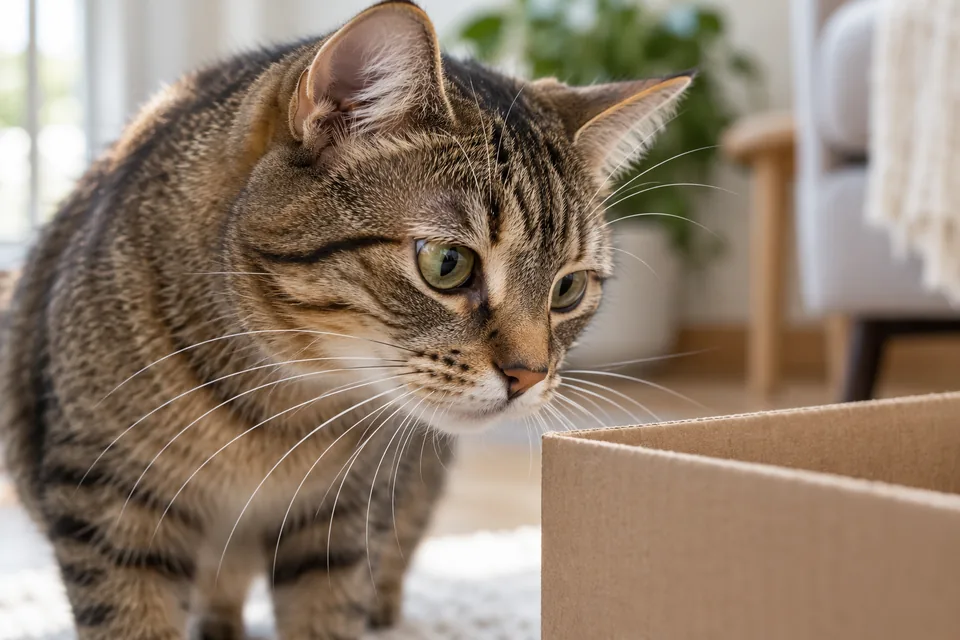
A cat investigating the edge of a box is gathering more than a picture. Its whiskers add information about the space around its face.
The message starts at the root
Whiskers sit deeper in the skin than ordinary fur. When a whisker bends, sensitive structures around its base send signals to the brain. Cats Protection explains how this helps cats sense objects up close.
Think of touching a wall with the end of a long paintbrush: the movement reaches your hand even before your fingers reach the wall. Whiskers give touch that extra reach.
More than a moustache
The scientific name for these hairs is vibrissae. They are thicker and stiffer than ordinary fur. As the Natural History Museum of Los Angeles County explains, they extend a cat’s sense of touch.
There are whiskers above the eyes and on the front legs too. The face simply has the most familiar set.
They are useful sensory equipment, so leave them untrimmed. Cats Protection advises against cutting or plucking them.
Another cat question
Whiskers help with nearby space, but they do not explain every feline habit. Read why cats love boxes, or explore the different reasons cats purr.