
The answer starts on dry land
The ocean is salty because dissolved salts arrive from weathered rocks on land and from processes on the seafloor. When seawater evaporates, the salts stay behind.
A splash of seawater can make a beach sandwich unexpectedly well seasoned. The surprising part is that much of that salt began its journey nowhere near the beach.
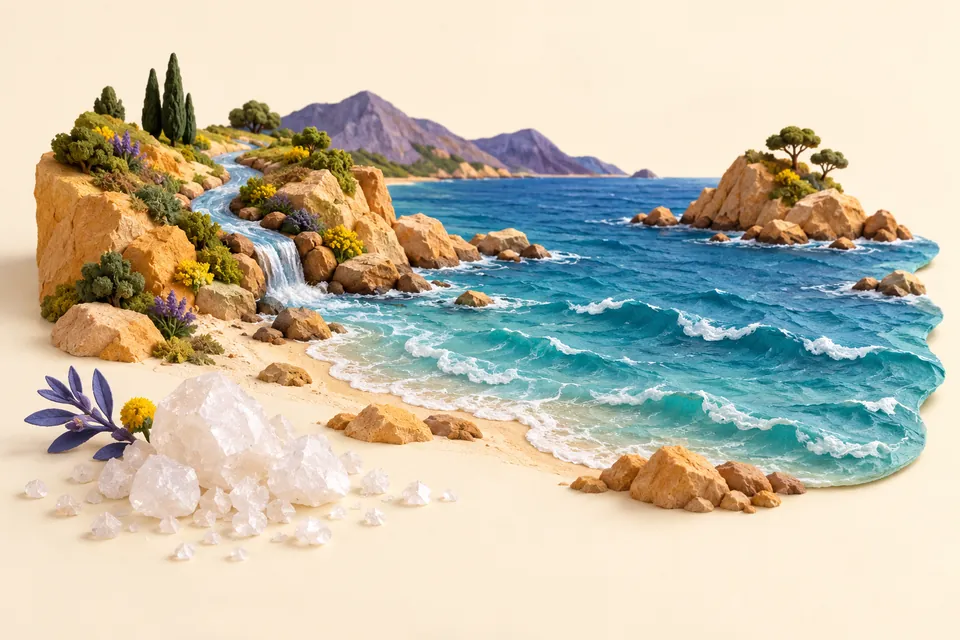
Rainwater is slightly acidic. As it reacts with rocks, it releases dissolved particles called ions. Streams and rivers carry them towards the sea. NOAA explains this route from rock to ocean, along with the contribution from seafloor vents.
So why do rivers taste fresh?
Fresh water is not completely salt-free. Rivers contain dissolved minerals, but usually in much smaller concentrations than seawater.
As Woods Hole Oceanographic Institution explains, rain adds far more fresh water than salt to rivers and lakes. The minerals are there; they are simply much more diluted. Fresh is a useful everyday description, rather than a claim that the water contains nothing else.
Water leaves. Salt stays.
Evaporation removes water from the sea without taking its dissolved salts along. Think of the difference between water disappearing from a salty puddle and someone carrying the whole puddle away.
That does not mean the ocean must keep getting saltier forever. Salt also leaves the water through natural processes, including becoming part of seafloor sediments. NOAA describes a broad balance between salt arriving and leaving.
About 35 grams in a kilogram
Average seawater contains roughly 35 grams of dissolved salts per kilogram of seawater: about 3.5% by mass. That is an average, not a recipe that fits every coast.
Woods Hole notes that salinity varies; the Mediterranean, for example, is saltier than the ocean average. Rain, river water and evaporation all help shape local differences.
For another familiar feature that hides a surprise, discover why Greenland looks so enormous on many maps.