
When and where will the eclipse be total?
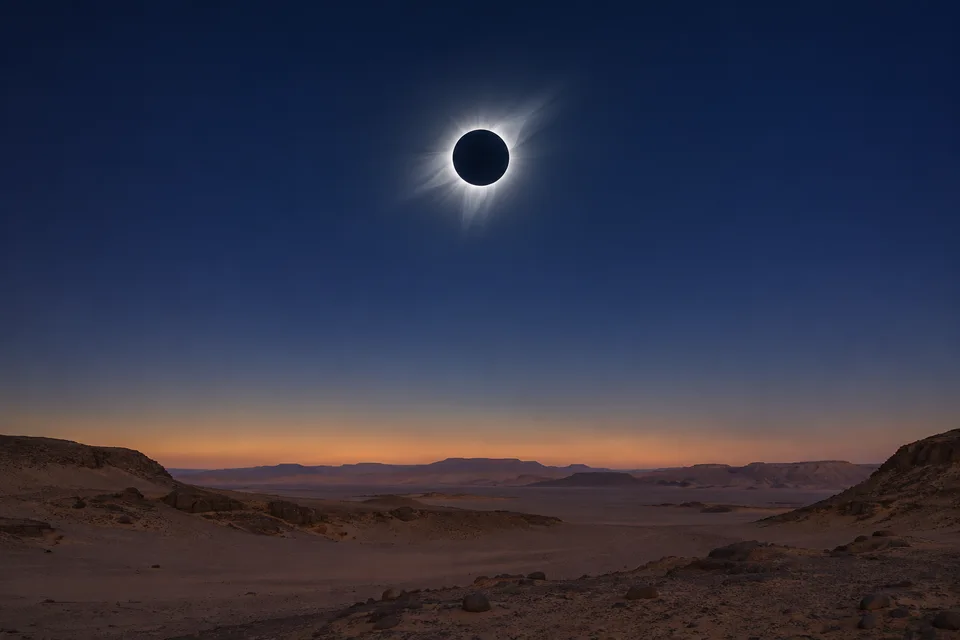
The total solar eclipse will take place on Monday 2 August 2027. The path of totality crosses southern Spain, northern Africa and parts of the Middle East. Near Luxor in Egypt, the Moon will hide the bright face of the Sun for up to 6 minutes and 23 seconds at the point of greatest eclipse.
The shadow crosses the Strait of Gibraltar, then moves through Morocco, Algeria, Tunisia, Libya and Egypt. It continues across parts of Saudi Arabia, Yemen and the far north-east of Somalia before ending over the Indian Ocean.
Outside that narrow path, much of Europe and Africa and parts of Asia will see a partial eclipse. Use the National Solar Observatory’s eclipse map to check your exact location and local times.
Why does totality last longer in Ceuta?
Spain’s Instituto Geográfico Nacional predicts about 2 minutes 54 seconds of totality in Cádiz and 4 minutes 48 seconds in Ceuta. Both are in the Moon’s shadow, but they sit in different parts of its path. Near the edge of the shadow, the Moon covers the whole Sun for less time.
So start with a town or postcode when checking a map. A country can lie partly inside the path, and even nearby cities can have very different views. Clouds can hide the eclipse from places where totality is predicted.
If you’re following the route on a map, our guide to the Strait of Gibraltar shows the narrow stretch of water between southern Spain and North Africa.
How to watch safely
Use eclipse glasses or a handheld solar viewer that complies with ISO 12312-2 whenever any part of the bright Sun is visible. Ordinary sunglasses cannot protect your eyes. If you are outside the path of totality, keep your solar viewer on every time you look at the Sun.
Inside the path, NASA says you can remove your viewer only while the Moon completely covers the bright face of the Sun. Put it back on as soon as any bright part returns. If you are unsure when totality starts or ends, keep it on. You can also watch a projected image with a pinhole projector while keeping your back to the Sun.
Is this the same as the February eclipse?
On 6 February 2027, an annular solar eclipse will leave a bright ring around the Moon along its own path. In August’s path of totality the bright disc disappears entirely. If you want to picture how the shadows line up, see our guide to the difference between solar and lunar eclipses.
While you’re waiting for eclipse day, the naked-eye guide to the night sky offers a few ordinary sky observations you can try close to home.