
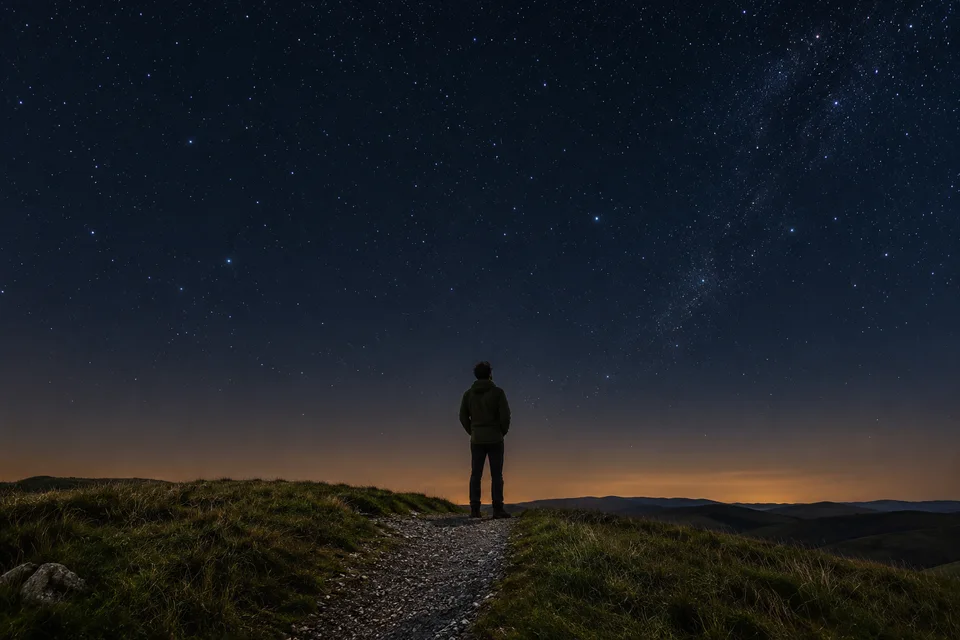
What can you see without a telescope?
Start with the Moon, a few bright stars and, on a suitable night, a meteor or a planet. Pick a safe spot with an open view, choose one thing to look for and check what is above your horizon at your location.
A clear evening from your doorstep is enough to try the first two steps. A dark site helps with faint objects, but you can already notice changes in the Moon from a bright town. NASA’s skywatching guide explains what changes with your location and season.
Make your first observation in ten minutes
Choose a safe place away from direct glare. Look across an open part of the sky. Let your eyes adjust as you settle in, and keep any screen dim if you need it for a sky chart.
- Pick a landmark. A tree or a roofline gives you something fixed to compare with the sky.
- Record the time and direction. Sketch where the object sits above that landmark, and note whether it looks round, curved, steady or flickery.
- Return at the same local time. If the view changes, use the sketch to say what changed. If clouds hide your target, record that too.
Here’s an example entry you could copy: ‘19:30, looking west. Thin crescent above the roof. Clear near the horizon.’ The date and location determine whether that crescent is actually there. If your chart shows it below the horizon, choose a different target.
Choose a target for the conditions you have
In a town: Start with the Moon, or choose a bright star from a chart set to your location and time. A streetlamp right beside you can make the sky seem emptier than it is. Try watching from the shadow of a building while keeping an open view of the sky.
Under a darker sky: Pick out one recognisable set of stars first. A sky full of faint points can make a familiar outline harder to spot. Match a small part of the chart to the sky, then work outwards.
On a cloudy night: Check whether your target is even due to be above the horizon. If it is, note where the clouds are and try again later. An unsuccessful search still tells you something if you can explain what blocked the view.
Find the Moon by its phase
The Moon reflects sunlight and can be above your horizon in daylight. If you see a half-lit Moon, the name of the phase gives you an idea of when to try again. NASA’s Moon phases guide shows the sequence and explains the changing view of the illuminated half.
- Why the Moon appears in daylight helps you choose a morning or an afternoon to look.
- Why the Moon seems to change shape shows what a sketch actually records when the bright edge moves.
Try drawing the bright edge first. On a second clear day, draw it again without looking at the first sketch. Compare the drawings afterwards.
Use a fixed horizon to compare the view
Keep the same landmark if you return several weeks later. Why the seasons change explains how Earth’s tilt affects the Sun’s path and the length of the day. The solstice and equinox guide helps you choose when to make a longer comparison.
At dusk, you can observe the colour of the sky away from the Sun. Why sunsets look red explains how the longer path through air changes what reaches you.
After dark, compare a bright point low down with one much higher. Why stars twinkle explains why a low star can look less steady and why steadiness is only a clue when you’re looking for a planet. Check your chart before naming it. NASA explains the difference between star and planet light.
Watch a broad patch of sky for meteors
A meteor is a brief streak from material entering Earth’s atmosphere. NASA’s meteor shower guide explains why showers recur and why a telescope is unnecessary. Give yourself a broad view, with bright lights out of sight. Check cloud cover and moonlight before setting out.
The October Orionids explains why a shower returns when its parent comet is far away. The December Geminids viewing guide gives you a worked example of choosing a local viewing window. Even on a peak night, conditions shape how many streaks you can see.
Plan eclipses separately
Use the comparison of solar and lunar eclipses to work out which object casts the shadow. Then use the 2027 total solar eclipse guide to see why two nearby places can have very different views.
Solar viewing needs its own safety plan. Ordinary sunglasses cannot protect your eyes. Follow NASA’s solar eclipse safety instructions before looking towards the Sun. The ordinary skywatching steps in this guide are for everything else.
What to try on your second night
Repeat one part of your first observation before looking for anything new. Keep the landmark and local time the same if you can. If you picked the Moon, compare its position and the shape of the bright edge. If you picked a star, compare how it looks when it is higher in the sky. Avoid drawing a general rule from one cloudy or hazy night.
In your notebook, keep the observation separate from the explanation. ‘I couldn’t see the star above the roof’ is an observation. ‘It had already set’ is one explanation; cloud and the roof itself are others. Check the chart, then use what you learn to plan your third look.