
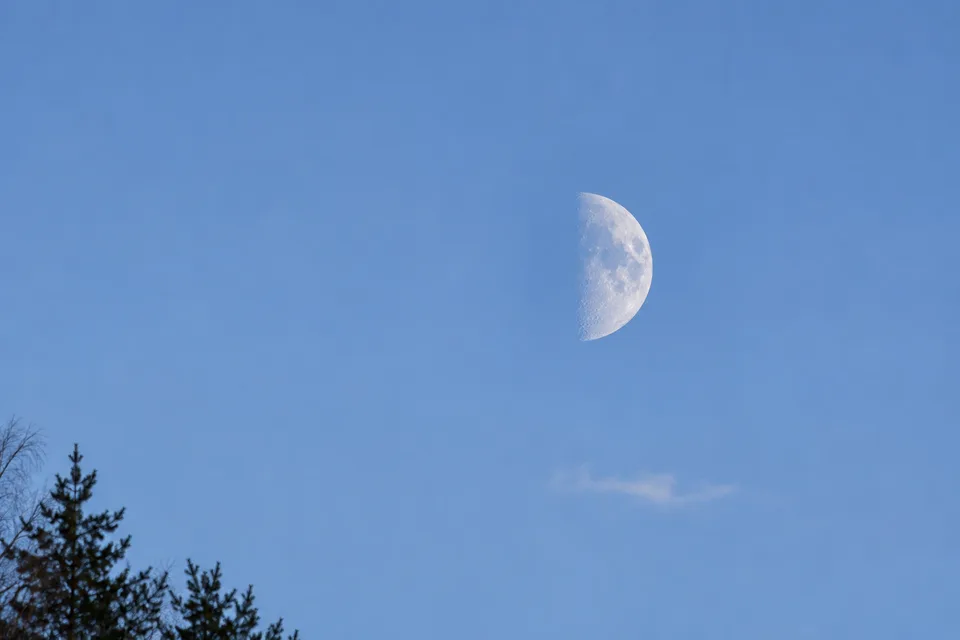
The Moon reflects sunlight
You can see the Moon during the day when it is above your horizon and reflects enough sunlight to stand out against the bright sky. The Sun can light the part of the Moon we see even while it is lighting the ground around us.
Daylight makes the Moon look faint, especially through haze. On a clear day, its pale shape can still stand out.
The phase tells you when to look
A half-lit Moon at first quarter typically rises around midday, so the afternoon is a good time to look. At third quarter it typically rises around midnight and stays up into the morning.
Both phases show us a half-lit disc. They appear on different sides of the Sun in the sky, which is why one is easier to find after lunch and the other before it. The exact times depend on where you are and the date.
At new Moon, the Moon is in the same part of the sky as the Sun. During the total solar eclipse of 2 August 2027, it will briefly cover the whole bright disc for people in a narrow path.
Once you’ve picked a morning or afternoon, use this guide to observing the sky with the naked eye to sketch the Moon against a fixed landmark and compare it on another day.
What about a full Moon?
A full Moon rises roughly around sunset and sets around sunrise. That is why it is most often seen at night, although you can sometimes catch it low in the sky while there is still daylight.
If you want to recognise those shapes, see why the Moon seems to change shape.