
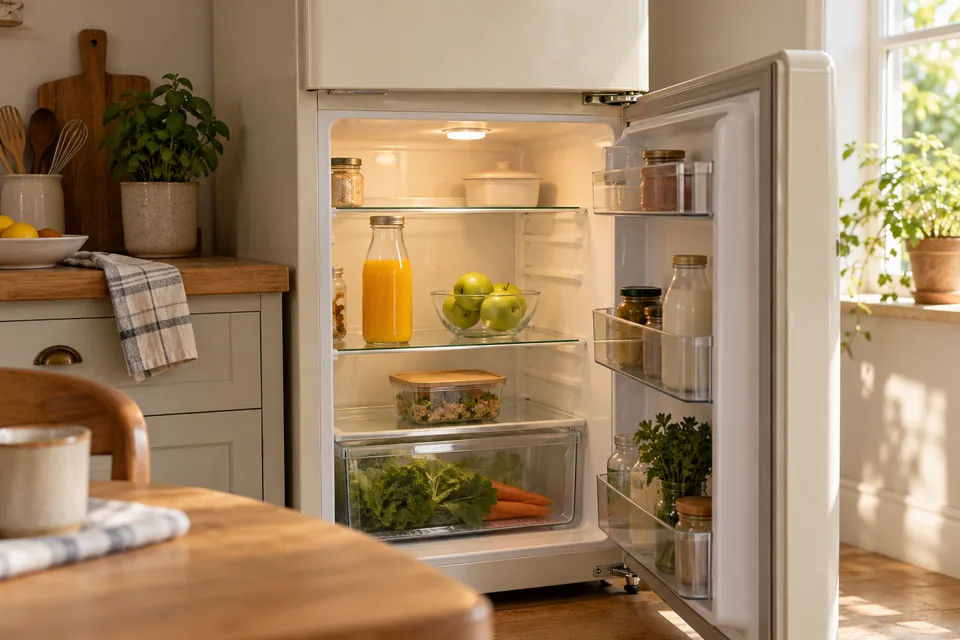
The juice loses some warmth
A typical household refrigerator keeps its contents cool by moving heat from inside the cabinet into the kitchen. A fluid called refrigerant travels around a sealed loop, changing between liquid and gas.
Picture a bottle of juice on the shelf. As it cools, energy leaves it. That warmth has a journey to make.
Inside: collecting heat
In the cold part of the loop, the refrigerant evaporates: it changes from liquid into gas while absorbing heat from the fridge’s interior.
NIST explains this heat-collecting and heat-releasing cycle. The evaporating fluid helps cool the space around it, including the air beside your bottle.
Outside: letting it go
The compressor squeezes the refrigerant gas, raising its pressure and temperature. The hot gas then reaches the condenser, where it releases heat to the room and turns back into liquid.
GE Appliances describes this sealed cooling system, including how the warmth leaves the appliance. A cold interior and warm air outside belong to the same job.
And round it goes
The liquid passes through a narrow capillary tube into the low-pressure evaporator, ready to absorb heat again. The refrigerant stays in its pipes; it is not the air moving around your carrots.
For a quieter way to control heat, meet the vacuum flask. Its clever gap slows heat transfer, while the fridge actively moves heat away.