
The same units on both sides
A map scale is a ratio between a distance on the map and the corresponding distance on the ground. At 1:50,000, one unit on the map represents 50,000 of the same units on the ground.
Ordnance Survey gives 1:50,000 as an example: 1 cm on the map stands for 50,000 cm, which is 500 metres. The ratio has not turned centimetres directly into kilometres; you convert the units afterwards.
A four-centimetre example
Imagine two marks 4 cm apart on a correctly sized 1:50,000 paper map. Multiply 4 by 50,000 to get 200,000 cm. Divide by 100 to get 2,000 metres, or 2 km.
For a second example, 1 cm at 1:25,000 represents 250 metres. So 4 cm represents 1 km. The same paper distance can mean different ground distances: read the scale first.
A route can bend
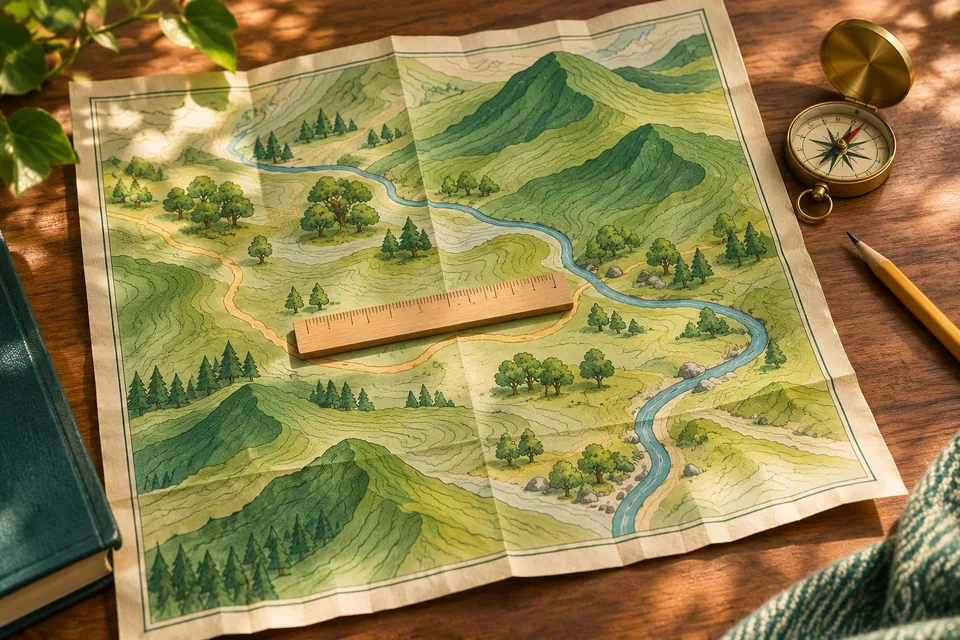
A ruler laid straight between two points measures their straight separation on the map. A path that winds around a lake may be longer. Follow the route’s bends when that is the distance you want.
Use the scale supplied with the map you are viewing. Enlarging or shrinking a map image changes what a centimetre on your screen or printout represents. Our Greenland map reading also explains why a flat world map can distort size.
Where, and how far?
Latitude and longitude locate a place; scale helps interpret distance. They answer different questions.
Return to Read a world map to connect the equator, the zero meridian, coordinates and scale. The optional questions below check the conversions, with explanations after you answer.
Distance is only one part of the picture. Read contour lines to compare height and steepness, then try a three-gap uphill example.