
Small, backward-facing spines
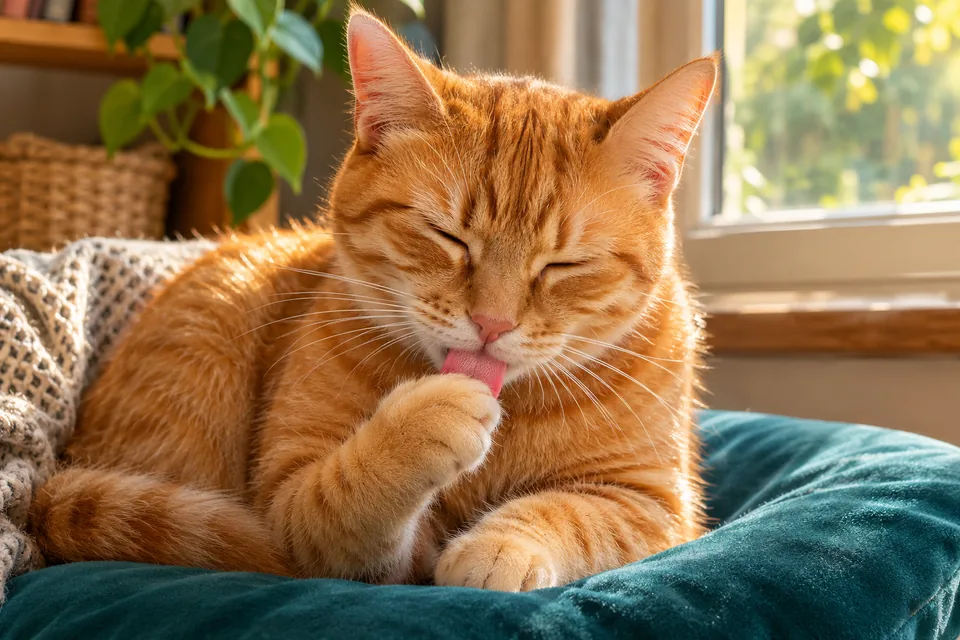
A cat’s tongue feels rough because it carries small, backward-facing spines called papillae. These stiff structures are made of keratin, the same material found in human fingernails.
Georgia Tech’s researchers describe the tongue as a flexible comb. Its roughness is part of a shaped surface that meets the fur during grooming.
A scoop at the tip
The grooming spines do more than catch hairs. In their 2018 study, Alexis Noel and David Hu found hollow cavities at the tips. These small spaces take up saliva and release it onto hairs as the tongue moves through the coat.
Imagine a comb that can carry a little liquid between its teeth as it passes through hair. That is a useful comparison, although the cat’s structures are tiny curved spines with scoop-like tips, rather than an ordinary bathroom comb.
The shape connects two jobs: moving through fur and carrying saliva into it. Describing the tongue as simply a flat, wet surface misses that structure.
How did researchers check?
Noel and Hu combined high-speed filming, force measurements and CT scans. They examined tongues from six cat species, including domestic cats and lions, rather than relying only on how a lick feels.
The scans revealed cavities; the observations and experiments helped show how saliva moves from the tongue into fur. Those are different pieces of evidence for the same mechanism.
Compare this grooming structure with the sensory job of whiskers and the uses of scratching. Follow the distinctions in Cats: whiskers, paws and purrs.