
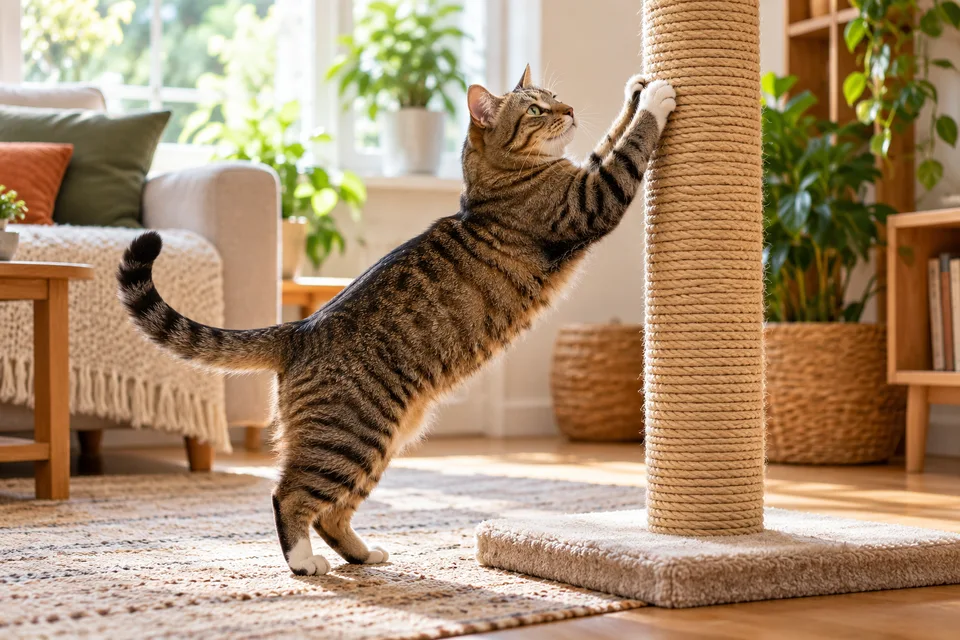
A scratch has several jobs
Cats scratch surfaces to help maintain their claws, stretch and leave marks that other cats can detect. A scrape on a post has more going on than the sound suggests.
Cats Protection explains that scratching is normal, instinctive behaviour. Keeping claws in condition and communicating are part of the same action.
The little claw-shaped husks
Cornell’s Feline Health Center explains that scratching removes the outer claw sheath. It can leave discarded claw-shaped husks behind. Finding one near a scratching post is different from finding an entire lost claw.
Picture a familiar corner after the cat has used it: a few pale husks and roughened fibres. Those visible traces are only part of the message.
A message our eyes cannot read
Cats have scent glands between their paw pads. Scratching leaves scent clues as well as visible marks. We can notice the grooves without noticing the chemical information.
That gives us a useful limit when watching a cat: one scratch alone does not tell us its whole mood or motive. The action can serve several purposes.
Why a sofa can become the target
A sturdy surface with a good grip can suit scratching, even if it happens to be furniture. Cats Protection recommends a stable scratching post tall enough for a full stretch. Cats often scratch and stretch after waking.
This reading is about scratching surfaces. For another paw movement, compare kneading. To explore a different part of a cat’s sensory equipment, meet its whiskers.