
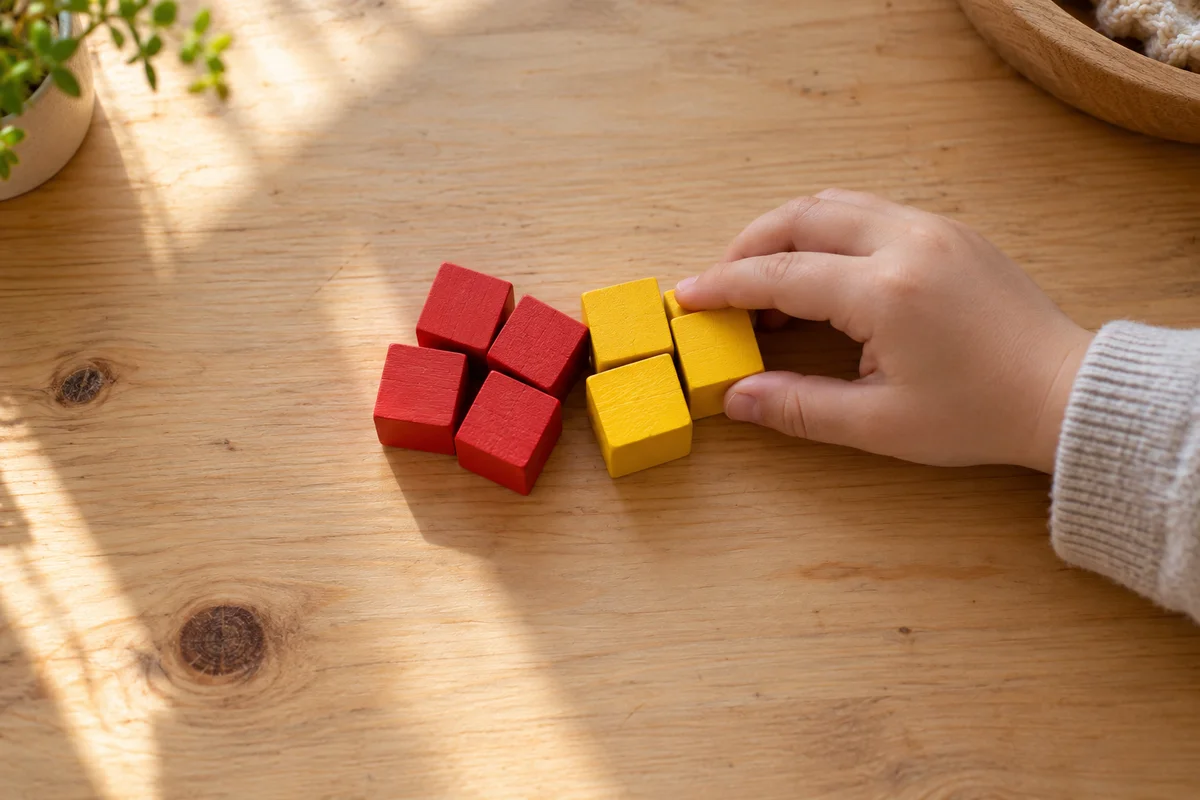
Two piles become one
Put 2 buttons on a table. Beside them, put 3 more buttons. Now slide the two piles together.
Count every button once: one, two, three, four, five. You have 5 altogether. You have just added two amounts.
That is a good place to start with addition: finding how many there are when amounts are put together. You can use buttons, blocks or your fingers. There is no timer here.
Make a sum you can see
Draw two circles on paper. Put two small objects inside one and three inside the other. Before counting, predict the total.
Move one object from the second circle to the first. You still have five, now arranged as three and two. Add a new object instead, and the total changes to six.
Those little signs tell the same story
Instead of drawing all the buttons, we can write 2 + 3 = 5. Here is how to read it.
| Sign | Meaning here |
|---|---|
| + | Plus: put the amounts together. |
| = | Equals: both sides have the same amount. |
Read the whole line as “two plus three equals five”. The answer to an addition is sometimes called the sum. Here, the sum is five.
You do not always have to start at one
Imagine you already counted 4 blocks. Someone gives you 2 more.
- Keep the first number, four, in your head.
- Count the first new block: five.
- Count the second new block: six.
You now have six blocks. We write that as 4 + 2 = 6. Counting every block from one would give the same answer.
What if nobody gives you any more?
If you have 4 blocks and receive no extra blocks, you still have 4. Zero means none, so we can write 4 + 0 = 4.
Try this: put 3 counters beside 2 counters. Then swap the piles. You still have five. Moving the piles does not create or remove anything.
Next, we will do the opposite sort of story: take some things away and see what is left.
For the full picture, explore seven friendly starting points for basic arithmetic.