
Start with what you have
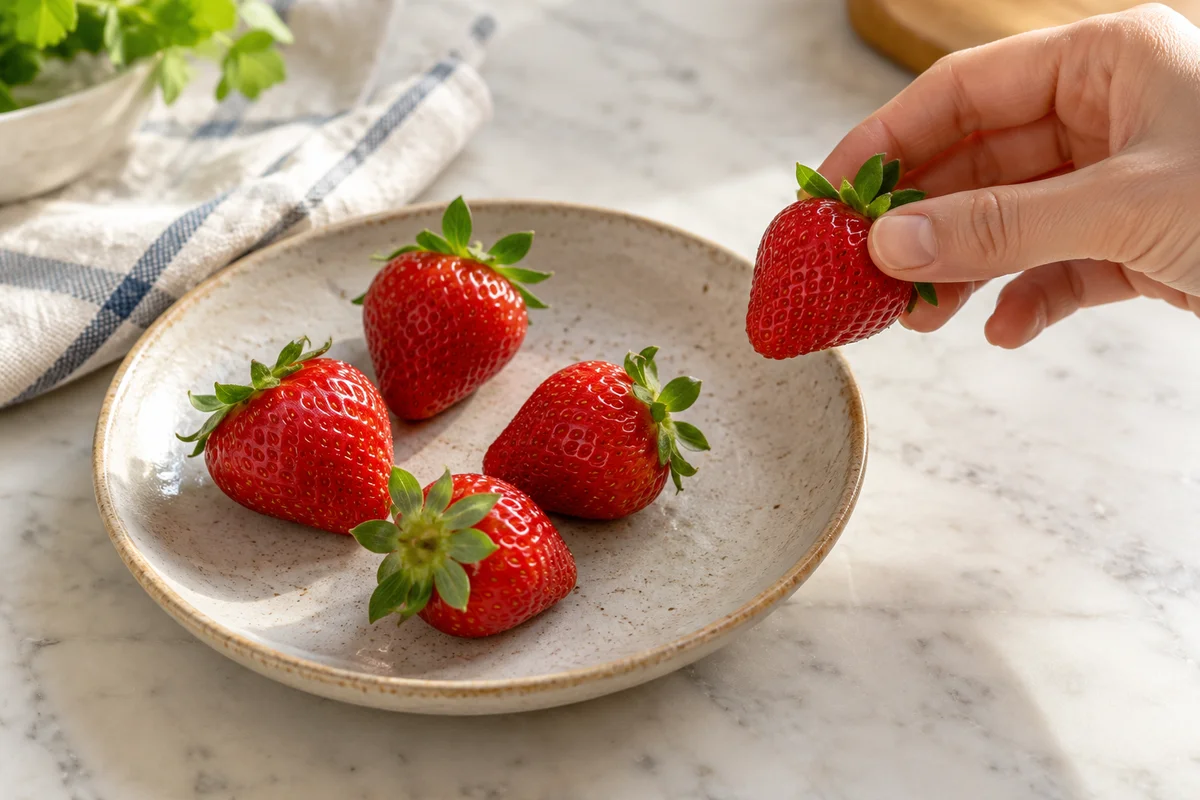
Imagine 6 strawberries on a plate. You eat 2. How many are still on the plate?
Take away one strawberry: five remain. Take away another: four remain. There are 4 left.
This is one way to understand subtraction: start with an amount, take some away, and find what remains. If you would like to practise counting first, start with our addition lesson.
Take a counter away
Draw six small circles on paper to stand for the strawberries. Cross out two. Count only the circles that have not been crossed out.
The two crossed-out circles show what you removed. Four remain, so 6 − 2 = 4. Try the same idea with five circles and one crossed out.
Meet the minus sign
We write our strawberry story as 6 − 2 = 4. Read it as “six minus two equals four”.
| Part | What it tells you |
|---|---|
| 6 | The amount you start with. |
| − 2 | Take away two. |
| = 4 | Four remain. |
The sign − means minus. The answer to a subtraction is also called the difference.
Put them back to check
You think four strawberries remain. How could you check?
- Start with those four remaining strawberries.
- Pretend to put the two you ate back on the plate.
- Count again. You have six, the amount you started with.
That check is 4 + 2 = 6. Adding back what you took away should return you to the starting amount.
Sometimes the answer is nothing
Start with 3 counters. Take away all 3. None remain, so 3 − 3 = 0.
If you take away nothing, all three stay: 3 − 0 = 3. These are different stories, even though they use the same numbers.
These examples remove only counters you already have. Later, negative numbers will let us describe other stories, such as owing money.
Next, see how equal groups make counting quicker.
For the full picture, explore seven friendly starting points for basic arithmetic.